
Cricket
Video killed a lot more than the radio star. Endless television coverage has ruined one of sport’s great joys: feeding the imagination. In the 20th century, when the written word was our primary source of information, the imagination ran free with everything from Andy Roberts’ quicker bouncer to Abdul Qadir’s googly. Now there is a patch over the mind’s eye. You can’t print the legend when the facts are on YouTube.
The best place to fuel the imagination, and indulge sporting mythology, is in the distant past, when technology was in its infancy and the odd Pathe newsreel is all we have.
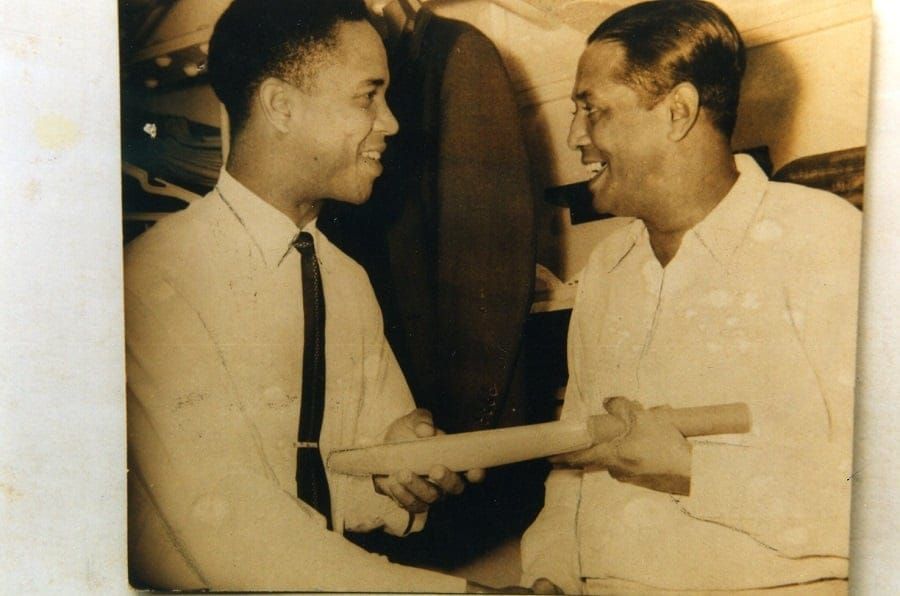
If you haven’t heard of Mahadeva Sathasivam, you’re in for a treat. Sathasivam played for Ceylon, now Sri Lanka, in the 1940s and 1950s, exhibiting such elegance and skill that Sir Frank Worrell reportedly said he would be the first name on a World XI teamsheet. His late cut was so magical that it should have been used to facilitate world peace.
The legend of ‘Satha’, as he was known to all, is summed up in Shehan Karunatilaka’s book Chinaman: "A gentleman drunk, a playboy who could play. Notorious for turning up at games minutes before the first ball, attired in the previous night’s evening dress, smelling of alcohol and someone else’s wife. Satha would order eggs and bacon at the clubhouse, shower, knock back a hair-of-the-dog scotch and score a scintillating double century."
Sathasivam was somewhere between Boy’s Own fantasy and modern anti-hero. He was serially unfaithful, probably a gambling addict, and was charged with murder when his wife was strangled to death in 1951. Sathasivam was eventually acquitted. After a 58-day trial, the jury returned a unanimous verdict in 64 minutes. There has always been speculation that, through his womanising and gambling, Sathsivam made enemies in extremely high places.
Satha was on remand for 625 days, during which he was reportedly visited by Worrell and Keith Miller. He was also great friends with Garry Sobers, a man who shared his disdain for a vanilla life.
Sathasivam was 35 when he was arrested, near his peak as a batsman. With Ceylon still decades away from becoming a full member, his chance to shine came in unofficial Tests against touring sides or for Ceylon in India and Pakistan. His 215 for Ceylon Cricket Association against Southern India in 1947 is rated by some as the best innings ever played at Chennai. It’s certainly the best played by somebody who made their last 61 runs while over the legal limit.
Satha’s walk to the wicket – think Viv Richards but played by a dandy – was an act of foreplay. On this particular day, he was offered a bottle of whisky by the benefactor Bernard Jayasuriya – but only if he made a hundred. Satha, 154 not out at the close, collected his reward on the way off, imbibed it over the next 12 hours and clattered his way home at 5am. Never mind the late cut, Satha was still half cut when he resumed his innings.
The former India captain Ghulam Ahmed, part of an excellent Southern India attack, was once asked to name the best player he had bowled to – a list that includes Don Bradman, Denis Compton, Miller and the three Ws. “You will not have heard of him, M. Sathasivam of Ceylon,” he said. “He did not allow me to land the ball most of the time… Satha with wonderful footwork treated every bowler with disdain… I have never seen a better innings in all my life.”
Ghulam wasn’t at Colombo in February 1950, when Sathasivam defied a vicious wet wicket to make 96 out of a total of 153 against a Commonwealth XI whose attack included Worrell. Channa Gunasekera, a contemporary of Sathasivam’s, saw the innings and wrote about it in The Willow Quartette. “On unfriendly turf this was beyond compare, something beyond what a mature imagination could conjure…. He demanded immortality.”
The tales of Sathasivam’s astonishing innings are legion, but it’s his style that put the mist in the eyes of grown men. In every sense, he looked a cut above: he usually batted in a silk shirt and cravat, cap perched at the jauntiest of angles. “Satha had the eye of a hawk; the wrists of a fencer; the feet of a dancer,” said Lucien de Zoysa, a legspinner and theatre director who played with him for Ceylon. The last bit was literally true, given he spent most of his evenings in the ballroom. Satha batted with a twinkle in his eye and an even brighter one in his toes. His footwork was decades ahead of its time.
He was also a classical 360-degree player, who played every orthodox shot except the hook; he preferred a dainty flick, as if waving a fly from under his nose. The late cut was his greatest shot, one that he played both classically and, on occasion, over the heads of the slips. There are also tales of no-look cover drives and dummying bowlers with exaggerated foot movement before the ball was bowled.
Sathasivam left plenty of runs out in the middle – he rarely stooped to running between the wickets, instead strolling singles, and one obituary noted that “fielding was not his delight”.
After his acquittal, Satha remarried and took his family to Singapore and Malaysia. He captained both, as well as Ceylon, and may be the only cricketer to lead three countries. He died of a heart attack in 1977, aged 62. Don’t count the years in his life; count the life in his years. And start imagining that late cut.
An earlier version of this piece appeared in Wisden Cricket Monthly