Will phallus
Edgbaston 2008, and the innings Graeme Smith was born to play
Never judge a day by its cover. On 2 August 2008, just after 5am, Graeme Smith awoke feeling dreadful. His back was groaning, his tennis elbow was screaming, and he was being tormented by thoughts that South Africa had blown it in England yet again. Smith, the personification of an up-and-at-’em attitude, could barely drag himself from bed; he missed breakfast before joining the team for their journey to Edgbaston. It turned out to be the defining day of Smith’s career.
His immense 154 not out – described by Wisden as ‘one of the all-time captain’s innings’ – was a miracle of will and power that gave South Africa their first series victory in England for 43 years and exorcised an army of ghosts. The fact it was Edgbaston, where South Africa suffered their greatest heartache in the World Cup semi-final against Australia in 1999, did not do any harm either.
South Africa’s relationship with the 50-over World Cup is one of sport’s tragically doomed love stories; until 2008, their relationship with touring England had a touch of Heathcliff and Cathy as well. The three series since their return from isolation followed soul-crushingly familiar patterns. Each time they stomped all over England to take the lead, only to fail wretchedly at the last. On each tour they lost the final Test. In 1994 and 2003 they drew the series; in 1998 they were beaten. They should have won all three. To err once might be considered unfortunate; to do so three times had everyone reaching for the ch-word.
This was the almost overbearing context in which Smith considered South Africa’s prospects on that Saturday morning. He should not even have been playing. He spent much of the build-up either in hospital or on the physio’s bench suffering from back spasms so severe that he couldn’t even go the toilet properly. On the morning of the game he pretty much failed a fitness test but played anyway. In his book, A Captain’s Diary, Smith estimates he was 70 to 75 per cent fit.
South Africa, deservedly 1-0 up in the series with two to play after thrashing England at Headingley, took control by dismissing England for 231. At 226-4 in reply, they had fingers on the Basil D’Oliveira Trophy. Then Andrew Flintoff memorably yorked Jacques Kallis in the gloaming at the end of day two, and the contest began to turn. South Africa were dismissed for 314. England finished the third day on 297-6, a dangerous lead of 214 on a wearing pitch, after a raucous 94 from Kevin Pietersen and a career-saving century from Paul Collingwood.
What troubled Smith as much as England’s lead was the speed at which they had accumulated it. South Africa’s watchwords – discipline, patience, control – had gone out the window as a seam attack missing the injured Dale Steyn lost their heads. Instead of bowling dry, they leaked runs. ‘We finished the day emotionally drained and very tired’, wrote Smith. ‘I was still struggling with my back, but my tennis elbow was even worse. I can cope with pain… but this was something I hadn’t experienced before.’ The mental strain was just as great. ‘It was driving me mad. I wanted the series so much. I was feeling pretty drained. I had room service, watched some arbitrary movie and tried to chill out as much as possible and get some rest.’
He didn’t get nearly enough. ‘I felt exhausted and wasn’t looking forward to the day’, he said of his feelings when he woke on the Saturday morning. ‘We had played so poorly the day before that I was still wincing from the memory.’ Not that anybody would have known. When Smith finally dragged himself from bed, he applied his game-face before joining the rest of the team. With the flick of an internal switch he became the omnipotent leader his team so depended on. ‘I obviously came across as bullet-proof. But my insides were eating themselves alive.’ The great captains have always been pretty good actors.
Smith would soon have the chance to write his own script. When England were eventually dismissed just before lunch for 363, South Africa were left with a target of 281 – a record score to win at Edgbaston, and the highest in a match between these sides for over a century. Big fourth-innings chases are not quite the Everest they once were – South Africa would chase over 400 against Australia at Perth later in the year – but these were extraordinary circumstances. It could have been a Krypton Factor endurance test: try going about your usual work while carrying tonnes of psychological baggage. South Africa knew that, with just over five sessions remaining and the weather good, this was it: they would either win the series or blow an almighty opportunity. If it had gone to 1-1 ahead of the final Test, the strain would surely have been too great for South Africa to win at The Oval.
In the five overs before lunch Smith struggled badly, particularly against Jimmy Anderson, at that stage a dangerous but erratic bowler. It seems ridiculous now, but in 2008 Anderson was regularly discussed in terms of Good Jimmy and Bad Jimmy. With the captaincy concerns still draining out of his brain, Smith was beaten as often as not in Anderson’s two overs, responding only with one impressive punch down the ground for four. He decided to sit alone at lunch to compose himself and gather his thoughts. He had no solids for lunch, just an energy sachet and a meal replacement drink.
It worked. Smith felt better immediately after the break and dealt far more comfortably with the rest of Anderson’s new-ball spell. With an unfit Ryan Sidebottom offering little threat, England turned to Flintoff and Monty Panesar, who was getting spiteful turn out of the rough to the left-hander. Smith and his opening partner Neil McKenzie proceeded fairly comfortably to 65 when an unsighted McKenzie offered no shot to a Flintoff yorker and was lbw.
It was the start of a farcical period in which a number of Flintoff’s deliveries were not seen by South Africa’s batsmen because of a sightscreen problem, with his release point lost in a couple of sliding doors just above screen level. It was only an issue with very full deliveries, only from Flintoff and almost exclusively to the right-handers. Nasser Hussain’s suggestion that it had something to do with snap of Flintoff’s wrist at the point of delivery was the most persuasive explanation.
Hashim Amla went soon after, lbw to Panesar for six. It was a decision that would have been overturned with DRS, as the ball was bouncing over the stumps. The new system was being trialled in the simultaneous Test series between Sri Lanka and India. In England the umpire’s word was final. Amla was out and South Africa were 78-2.
After the McKenzie dismissal, Smith took 19 consecutive deliveries from Flintoff so that the right-handers would not be exposed. Flintoff, playing his second Test after an 18-month absence, was at his most messianic and bowled a famous spell to Kallis in the first innings. It was Saturday afternoon, it was Edgbaston and a formidable opponent was chasing a target in the 280s to go 2-0 up – just as they had in 2005 when Flintoff, in the space of one over, changed from an ordinary human being into SuperFred. A raucous crowd, consumed with the cult of Freddie, expected something similar three years on. It wasn’t quite a World XI at one end and Ilford seconds at the other – as Graham Gooch famously said of the New Zealand side containing Richard Hadlee in 1986 – but it did feel like there were two separate games going on: when Flintoff was bowling and when he was not. With the window adding to his already abundant threat, there was a danger South Africa would drown in testosterone.
Smith’s vigil almost saw Flintoff out of the attack. But with Kallis on strike at the end of Panesar’s over, Flintoff was given one last burst, the eighth over of his spell. It worked. Kallis, again unsighted, ducked into a thigh-high full toss and was lbw to Flintoff. He swished his bat furiously, almost knocking over the stumps, and walked off swearing at either the umpires, Dame Fortune or both. One of South Africa’s most important Tests in decades was turning into a farce.
It would have been easy – understandable even – if Smith accepted that some things weren’t meant to be, that fate had found yet another perverse way to stop South Africa winning in England. It would have been easy to let the mental tiredness take hold – even more so when Ashwell Prince nicked Anderson behind to leave South Africa 93-4, still 188 from victory. Instead the problem with the windows provided an even bigger window into Smith’s soul and his indecent strength of character. He did not so much cope with pressure as ignore it. ‘I was feeling very little emotion, strangely enough’, he said. ‘I was concentrating hard on staying calm and focused, thinking about my batting and what I needed to do. It obviously wasn’t a very calm environment, but it was a simple case of logic. If I wasn’t calm, we lost the Test match. I needed to be calm, therefore I was.’
He reached his fifty from 86 balls, and at tea South Africa were 111-4. For the first part of the innings he looked ahead only in 10-run segments. When South Africa reached 120-4, he says in A Captain’s Diary, he started to consider the bigger picture. By then he was so sure he would see the innings through and score between 50 and 60 per cent of the runs that he started to halve the necessary target. In many men this would be a dangerous conceit; with Smith it was a simple case of logic.
By now he was engaged in a fascinating battle with Panesar, who was spitting the ball viciously out of the rough. Most only had eyes for Flintoff but Smith perceived a far greater danger. Panesar was at his most hyperactive, appealing for something unspecified almost every delivery. ‘It was obvious he was the biggest threat’, said Smith. He played Panesar more respectfully than the seamers, and with a simple plan: to get outside off stump and take lbw out of the equation. Twenty-two of his 31 scoring strokes off Panesar were to leg. Those works to leg off Panesar defined his innings almost as much as the belting drives through mid-off and thumping pulls that accounted for more than half of his 17 boundaries.
Those boundaries dried up for a time, with Smith hitting none in an 18-over spell that also included the most difficult period of his innings. On 74 he padded up to a wickedly spinning delivery from Panesar and survived a huge lbw shout. Hawkeye suggested it would have hit the stumps although, given the level of guesswork involved, Aleem Dar’s decision was an understandable one. Four overs later Smith should have been run out. He called the striker, AB de Villiers, through for a tight leg bye when the ball dropped on the leg side. Had wicket-keeper Tim Ambrose’s throw hit the stumps, or had it been claimed by Ian Bell, Smith would have been gone for 79.
In Panesar’s next over there was a very gentle inquiry – if that – for a catch down the leg side. Dar had no real appeal to answer, yet replays showed it had clearly hit the glove. Panesar was the only man who might have seen it, with all the other England fielders behind the bat and unsighted. But having appealed for everything all day, he went quiet. Smith survived. In a long essay about this innings in A Captain’s Diary, Smith does not even mention this chance, as if the personal omerta of not walking extends beyond the field of play.
Smith, flustered for the only time in his innings apart from that pre-lunch spell, slogswept the next ball towards deep mid-wicket, where Andrew Strauss was so close to taking the catch as he dived forward that many of the crowd thought they had finally seen the mighty oak felled. A split-second later Strauss’s body language betrayed the fact it had bounced fractionally short.
A drinks break a few moments later certainly helped Smith. England’s over-rate didn’t; an hour into the evening session there were still 31 overs remaining, extending a day that had, for Smith, begun almost 12 hours ago. Yet he seemed to find a second wind and began to again bat with formidable authority. He was surely further empowered by seeing off another six-over spell from Flintoff, who had now bowled 14 in little over three hours. At that stage Smith had faced more than two-thirds of the deliveries of Flintoff. Even if he thought Panesar was the biggest threat, it was a textbook example of his selflessness.
He lost AB de Villiers with the score at 171, caught at slip off Panesar. South Africa needed 110, with Smith and his grizzled lieutenant Mark Boucher at the crease and an unusually long tail to follow. At least he had a partner he trusted implicitly, who would be stimulated rather than cowed by the challenge, and who – having toured England in 1998 and 2003 – knew precisely what it meant. Smith said the first 30-40 minutes of his partnership with Boucher were ‘as much tension as I have ever experienced’.
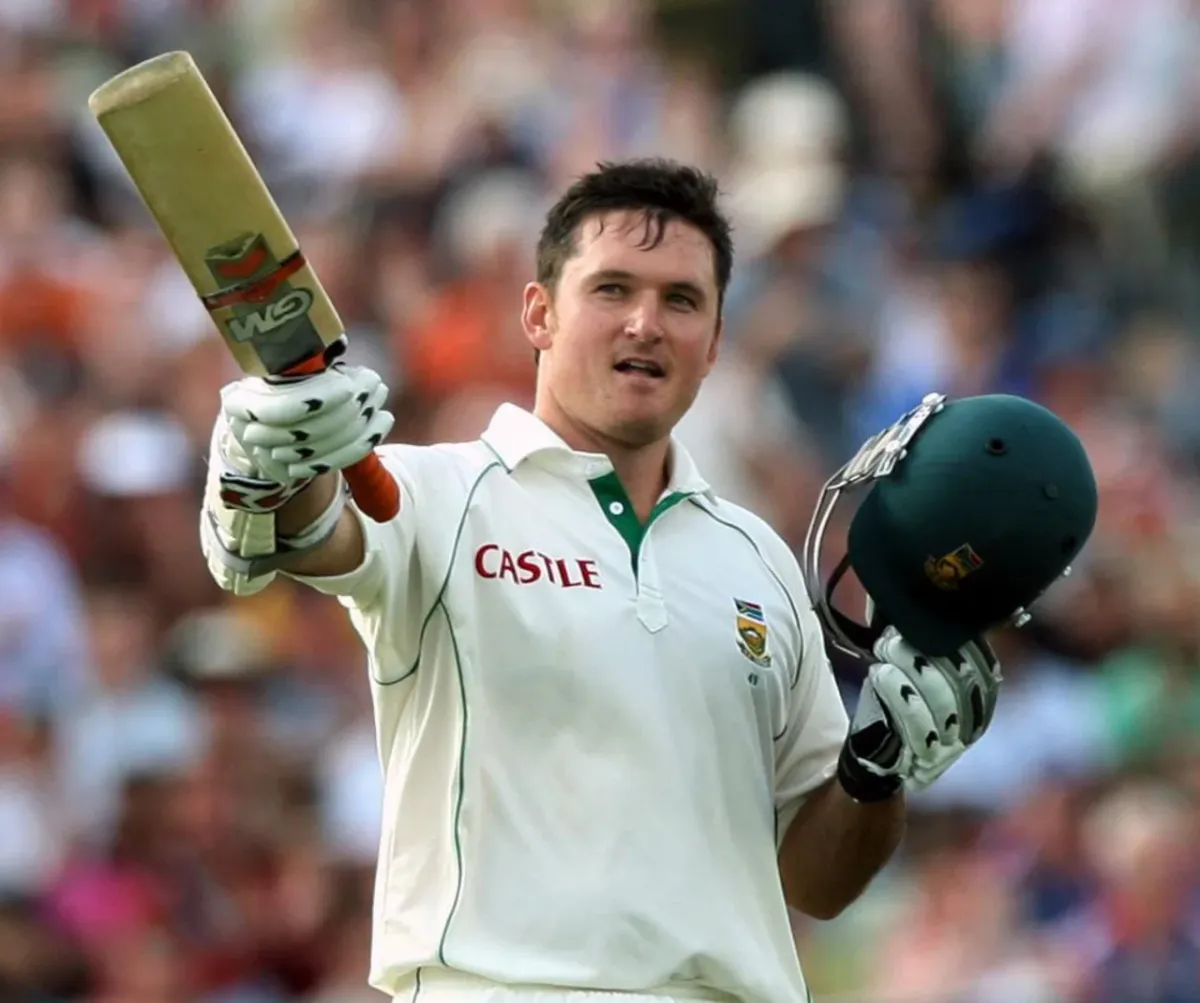
In that spell came the fleeting relief of reaching a century from 177 balls. Smith’s celebration was notable only for how muted it was. Not that anyone doubted it, but he made it doubly clear that business was unfinished. He knew the worth of the innings would be decided by the next two hours, not the previous three. At first he and Boucher were content to survive, with 12 runs from their first seven overs together. But with every dot ball the momentum shifted almost imperceptibly until they sensed a slight England weariness.
England only had a four-man attack; Sidebottom was at half ratpower and Panesar’s will had been broken by Smith. South Africa ran with the mood, and what started as an exploratory counter-attack soon became a brazen assault on a tiring attack. Smith asked Boucher if he wanted him to take Flintoff; Boucher said no and the pair tucked in to some weary bowling. The tactic was also designed to reduce the potential time the tailend might have against the second new ball. They could not have planned it better: the winning runs eventually came off the final ball of the 80th over.
The umpire Steve Davis checked the light meter at 198-5. There was only one side who wanted to go off. South Africa had scored 21 from the last three overs and England were assuming the mercy position. The partnership was a mini masterpiece of game management and controlled aggression. Smith hadn’t just silenced the crowd; he’d sent them home. Edgbaston, drunken and boisterous only an hour before, was now quiet and emptying, tedious partisan concerns overriding the chance to see the completion of one of the great innings. By now Smith looked as if he could go all night. He outlasted England both physically and mentally. It was not necessarily that he wanted it more, but he and South Africa certainly needed it more. With 24 runs needed, he claimed the extra half-hour. Soon after he brought up his 150 from 237 balls. The third fifty had taken only 60 deliveries.
Smith’s next scoring stroke was the most cathartic of his career. He pulled his old friend Pietersen for four to move to 154 and seal South Africa’s first series victory in England since the pre-isolation days of Graeme Pollock and Eddie Barlow. His team charged on to the field to embrace a man who was both peer and hero. Smith faced 246 balls, hitting 17 fours. He had withstood tennis elbow, a bad back, a dodgy sightscreen, the force of Flintoff’s personality, the rough outside his off stump, a lack of solids, a 47-over session and 45 years of history. He left pieces of his soul all over the Edgbaston wicket. If great and legend are the most abused words in sport, then epic is not far behind. Even the most pedantic, curmudgeonly patriot in England would concur this was an epic innings. Perhaps the biggest compliment you can pay Smith is that the scale and manner of that innings were not remotely surprising. It is the innings he was born to play.
On a personal level, Smith upgraded the archetypal captain’s innings for the 21st century. It had all the over-my-dead-body qualities associated with the genre, but its purpose was victory rather than the avoidance of defeat, and he scored at a 21st-century strike-rate of 63. In some ways this was the completion of an almost Shakespearean character arc. He lost his way after the spectacular start to his captaincy career in England in 2003. He went two-and-a-half years without a Test century between 2005 and 2007 and was often criticised for immaturity or boorishness and embarrassingly misplaced machismo. He did not make the Wisden Almanack list of the world’s 40 best players in 2006 and 2007. In 2008, still aged only 27, he matured into the spiritual heir to Steve Waugh he had promised to be on the previous tour of England.
Smith scored 277 at Edgbaston on that tour. This innings trumped it comfortably. It is one cricket’s fascinations that 154 can be greater than 277, 153 greater than 375 and 154 greater than 333. Everybody knew instinctively that this was an innings Smith would never top. Just as you can’t put the genie back in the bottle, so you can’t put the monkey back on the back. It is the second-highest innings by a captain in a successful fourth-innings run chase, behind Don Bradman’s 173 not out at Headingley in 1948. Captains are supposed to set the tone but Smith knows it’s even more important to set the tone in a different sense – to cement the final judgement of a match. He is a rough-track bully, addicted to tough runs.
The opportunity to play this kind of innings is what gets Smith going, and he is the only man in history to score 1,000 Test runs in successful fourth-innings chases. That includes four centuries. Only one other captain – Ricky Ponting – has managed even two. Smith is arguably cricket’s greatest triumph of substance over style, a man who can will his way to Test hundreds. And, while this was one of his better-looking innings – there was plenty going on in the V – it is remembered for its significance rather than its aesthetics.
Smith bent a match, a series and even history to his granite will. Thereafter South Africa’s series in England would be discussed in entirely different terms. Instead of wondering if South Africa would ever win, focus turned to whether Smith would see off another England captain. Michael Vaughan resigned the day after Smith’s 154, following Nasser Hussain’s decision to quit in 2003. And four years later, Smith’s team prompted the retirement of Andrew Strauss as well.
It is easy to forget, in view of England’s lost years under Peter Moores, just how much victory meant, both to South Africa in 2008 and India a year earlier. Smith described it as the ‘first massive stepping stone’ of a team who went on to become irrefutably the world’s best. In some ways it was also their final frontier, not because of what they achieved so much as what they had been through to achieve it. South Africa won in Australia for the first time later that year, a far greater feat but one that, following heavy beatings in 2001-02 and 2005-06, came out of nowhere rather than at the end of a long journey. The win in England was not just for his current team-mates: it was for Hansie Cronje, Kepler Wessels, Allan Donald, Shaun Pollock, Gary Kirsten and the others who had been denied in 1994, 1998 and 2003.
After the match Smith returned to the dressing room to drink with his team-mates. ‘Jeez it was a really special feeling.’ For a consummate team man, these are the moments that take up a lease in the memory bank. Amid the dressing-room celebrations, McKenzie and Boucher made Smith ‘down a beer or two in a compromised position for having die groot balles to bat through to the end’. The team eventually went back to the Radisson Hotel to continue their celebrations. At around 11pm, Smith realised he had not eaten all day, and slipped out to eat alone at a Lebanese cafe near the hotel. He says that, as he sat fiddling with a plastic knife and fork and a paper plate, the scale of the achievement sank in for the first time.
The team shambled to bed in the small hours. The following morning Smith was ripped from his sleep – not by nerves this time but by a fire alarm, which kept the players out on the street for 45 minutes. His back and his elbow hurt; he had a pulsating hangover. Graeme Smith awoke feeling dreadful. It was the most beautiful pain of his life.