
Cricket
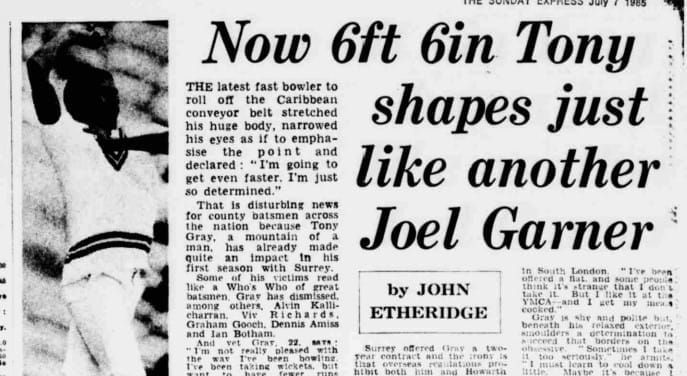
Joel Garner played his last Test at Christchurch in March 1987. So did his successor. Tony Gray was supposed to be Big Bird II, the man who trampled on international batters for the next decade. But he played his last Test at 23 and his last ODI at 27.
Gray’s career is one of cricket’s unsolved mysteries. He is the only proper bowler in men’s cricket history – Chris Smith’s right-arm slow doesn’t count – to average under 20 in both Tests and ODIs. And while the sample size is small (five Tests, 25 ODIs) a first-class record of 451 wickets at 23, including 178 at less than 20 in his first three years of county cricket, hint at one of the great lost fast bowlers.
Two reasons are usually cited for Gray’s brief international career: the quality of the fast-bowling competition and a succession of injuries. There is truth in both, but they’re a long way from providing the whole truth.
Gray was a bowling coach’s dream. He was 6ft 7ins, with an intelligence and natural lift that allowed him to play all kinds of music: chin, rib, armpit, shin. He swung and seamed the ball at around 88 mph and had a smothering accuracy developed out of necessity on the spin-friendly surfaces in Trinidad.
Gray was the first true fast bowler from Trinidad & Tobago to play Test cricket since 1951 and an inspiration for a teenage Ian Bishop. He began his first full season, 1984-85, by flattening Jamaica with a ten-for at Sabina Park. T&T, bottom the previous season, went on to win their only Shell Shield title between 1976 and 2006. Gray was recommended to Surrey the same year; within two months of arriving as an unknown, Ian Botham was describing him as “the talk of the circuit”. Gray took 79 Championship wickets at 23 that season, including a hat-trick and 8 for 40 against Yorkshire.
Botham was one of many who found a certain comparison irresistible. “Joel Garner,” wrote David Gower in 1985, “is a unique physical specimen (or, at least, I thought he was until I saw Tony Gray).” Gower’s mate Allan Border was equally complimentary in his 1986 county diary, especially about Gray’s lift: “It ends up being easier to head the ball, soccer style, than get a bat to it!”
Qasim Umar probably wouldn’t have used the exclamation mark. That year he became Gray’s first Test victim when he was hit on the helmet and staggered like a zombie into his stumps. Gray played all three Tests in a 1-1 draw in Pakistan, the start of an epic if short-lived rivalry between the sides, and finished with 14 wickets at 16. “I thought,” he said when he got home, “I could have done much better in terms of wickets.” He added eight more in two Tests in New Zealand, including a matchwinning snorter to dismiss Martin Crowe for 104 in the final session at Auckland.
Then things started to turn weird. Gray began his ODI career just as spectacularly – average 17, economy rate 3.5 – but was left out of the XI for the first four games of the 1987 World Cup. In the Manchester Guardian, Mike Selvey described his omission as “extraordinary”; in the Trinidad Guardian, the famous critic Ken Ramchand saw Selvey’s verdict and raised it to “criminal and insane”.
Gray was recalled for the fifth game against England. The day before, in the nets, he broke his wrist when a ball from – how’s your luck – Carl Hooper hit a tuft of grass and took off.
A few months later Gray pulled out of a vital Test against Pakistan, on his home ground in Trinidad, with a hip injury. “Had I played,” he says now, “I would have managed two overs at the most.” In that case, West Indies’ unbeaten run would probably have lasted eight years rather than 15. Yet Gray was criticised for letting the side down and word started to spread that he either didn’t fancy it or didn’t want it enough.
By the time Gray returned to first-class cricket 10 months later, even some of his biggest fans in the Trinidad & Tobago media were starting to question him. “There are those,” wrote one, “who believe that he is becoming a bellyacher.”
The invisibility and perceived vagueness of Gray’s injuries – nobody questioned the broken wrist – invited loose talk. It was also his misfortune that, in the late 1980s, cricket was the best place to find world-leading experts in hip and soft-tissue injuries, people who knew Gray’s body far better than he did.
Either that or they were peddling ignorant, macho-fantasy horse pucky. Few knew Gray was born with one leg shorter than the other, which had a domino effect on his body, or that he suffered with epilepsy. Empathy voids did not begin with social media.
The injuries, the whispers about his character and the selection of inferior bowlers fostered a corrosive negativity that perpetuated itself and had a different kind of domino effect. It's hard to reconcile those whispers with the reality of Gray’s career. Take two examples. In his debut series in Pakistan – Pakistan – he regularly bowled spells of more than 10 overs. And in 1982 he took on India Schools against medical advice after suffering an epileptic fit on the outfield before the game.
Unsolved mysteries invite idle speculation. The most popular involved the West Indies captain. Tommy Joseph, a famous T&T comedian, was apparently known to ask his audience: “What’s Viv Richards’ least favourite colour? Gray.” Richards’ opinion of Gray, good or bad, isn’t on public record.
Gray was 24 when he missed that Pakistan Test; he played only four more ODIs for West Indies, all against Australia in 1991, and was dropped two games after taking 6 for 50 in Trinidad. He slowly accepted his international career was over and retired at the age of 32.
A decade earlier, when Gray was spreading fear in the shires, Botham glimpsed a chilling future for batsmen. “He’s nothing like as quick as he’s going to be – and has got quite a bit to learn yet. When he gets everything sorted out… he could be quite formidable.”
We never quite got to find out.