
Football
Norwich City (1988-89)
Many people remember Norwich's heroic attempt to win the inaugural Premier League; fewer recall their equally intrepid challenge four years earlier. For much of the Michael Thomas title race, doubting Thomases were wondering when Norwich would collapse: not only did they lead the league for much of the season, they also reached the FA Cup semi-finals, walloping giantkillers Sutton 8-0 en route.
Dave Stringer's side, who had finished 14th the previous season, got off to a flying start, winning the first four games and eight of the first 11. With the exception of one weekend in October, they led the table from mid-September to New Year's Eve. That run took in a dramatic late win at Old Trafford – when Mike Phelan scored a sensational half-volley – and their first victory at Anfield for 13 years.
Robert Fleck's outrageous last-minute winner settled a televised thriller at Millwall in January, and Norwich took a staggering 29 points from 13 away games up to the end of March. On 1 April they hosted an in-form Liverpool. Norwich were two points ahead of them and three behind the leaders Arsenal, on whom they had a game in hand. Liverpool won 1-0, and Norwich's challenge for the double collapsed: they lost six of the last 10, including an inevitably forgotten FA Cup semi-final against Everton (on the same day as Hillsborough) and a May Day hammering by Arsenal on live TV.
They finished the season in fourth, 14 points behind Arsenal and Liverpool. It's said the table never lies but, in suggesting that Norwich weren't really part of the 1988-89 title race, it is certainly being economical with the truth.
Aston Villa (1989-90)
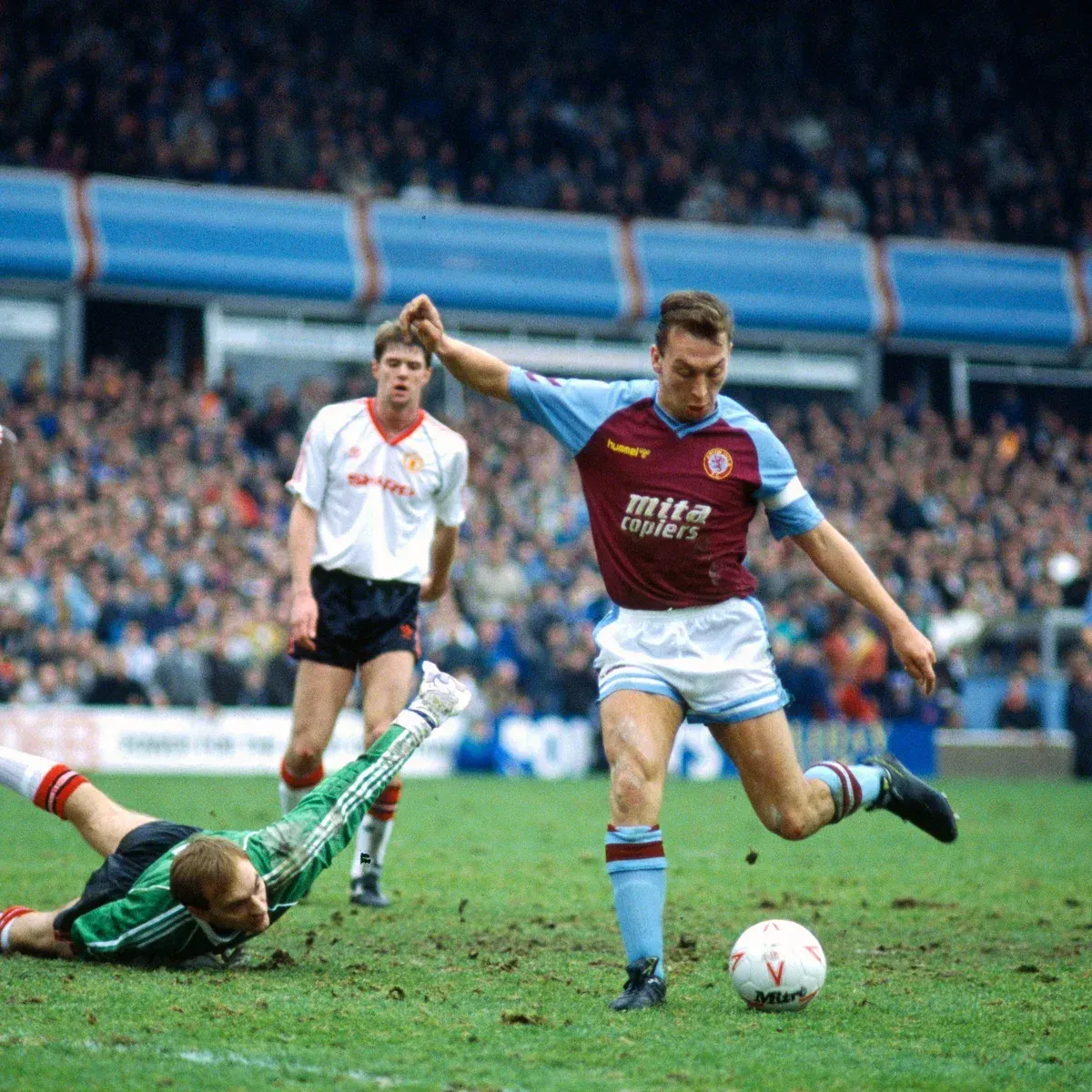
In 1988-89, Aston Villa finished 17th. In 1990-91, they finished 17th. If this were a maths puzzle, they would have finished 17th in 1989-90 and that would be the end of the most boring piece of journalism in history. They didn't, they finished second. It's another reminder that, of his generation of British club managers, Graham Taylor had few peers.
Taylor is often written off as a dinosaur because of his preference for direct football. It's a risibly shallow view, not least because his mind was so open and inquisitive. At a time when pretty much everyone in England played with a back four, Taylor found great success with a kind of 5-2-3 formation and what looked like a motley crew of geriatricos (Paul McGrath, Gordon Cowans, Nigel Spink, Derek Mountfield) and England Under-21 stars (David Platt, who started the 1989-90 season as a nobody and the 1990-91 season as a nationwide celebrity, Ian Olney, Tony Daley). They also had the gangling Ian Ormondroyd on the left wing, an aesthetically preposterous move (imagine Peter Crouch hugging the touchline) that actually worked well.
After a dodgy start to the season left them in their apparently preordained position of 17th after seven games, Villa went on a stonking run in the league: P18 W15 D1 L2. It included a staggering 6-2 demolition of Everton on live TV*, a good draw at Anfield and an emphatic 2-1 defeat of the champions Arsenal, in which Platt scored the most charming goal after a thrilling piece of deception – very similar, oddly, to a goal scored for another claret-and-blue-side against Arsenal 10 years later. The last of that run of 18 games was an ominous 2-0 victory away to a fine Spurs side, who would finish third. It took Villa top for the first time. They were undeniably the best team in the country.
Three days later, their burgeoning party was pooped devastatingly by Wimbledon, who took great pleasure in winning 3-0 at Villa Park. From there, it all went wrong: Villa lost five of the next 10 and Liverpool, though not quite at their best, won the title with two games to spare. Much was made of the March signing of Tony Cascarino, who didn't score in his first eight games and joined Rodney Marsh on the list of players who supposedly nixed what wasn't broke. To ascribe Villa's failure to him seems more than a little unfair, an oversimplification of cause and effect. More likely is that, as so often happens with unlikely title challengers, the gravity of what they were about to achieve overwhelmed them.
* Younger readers, assuming there are any, may wonder why we keep prattling on about live TV games. In those days the weekly televised match was a major social event. You haven't known joy until you've had a weekly fix of The Match theme tune and Elton Welsby.
Newcastle United (2001-02)
The list of great title races is comprised almost entirely of those that go to the last day. It's a peculiar thing, not unlike having a list of great films comprised almost entirely of those with a twist ending. The 2001-02 Premier League title race did not go to the final day, but it was utterly compelling, largely for two reasons: the unprecedented excellence of the top three – Arsenal, Liverpool and Manchester United – in the last four months of the season (their combined record was P52 W40 D8 L4, and many of those dropped points were against each other) and the fact that, for much of the campaign, the title race was polygonal.
Only three points separated five teams at the turn of the year and, after Leeds faded, only four points separated the top four at the start of March. The other team? Sir Bobby Robson's Newcastle, whose role in the race is rarely mentioned. Yet had they beaten Arsenal on 2 March – the game in which Dennis Bergkamp decided to score the umpteenth career-defining goal of his career – they would have gone top of the table. For most of the season they were brilliantly inconsistent, capable of beating the champions Manchester United 4-3 one week and getting thrashed 3-0 at West Ham the next. At first they were not taken seriously, but their burgeoning title challenge could not be ignored after they won at Highbury and Elland Road in four glorious days just before Christmas. They come from behind both times, to win 3-1 in a fractious match against Arsenal, and from 3-1 down to win beat Leeds 4-3 in an immense match.
Nolberto Solano's last-minute winner that day came after an exquisite pass from Kieron Dyer, playing perhaps the best football of his career. He and the new signing Craig Bellamy added a devastating electricity to the side, while Alan Shearer was as merciless as ever in front of goal. Dyer was playing so well that Bellamy said he was the best player he had ever played with, a list that included Ryan Giggs. "He will be at the World Cup and he will be a superstar," said Bellamy. "Real Madrid and all the top Italian clubs must all want him."
You'll laugh now, but it didn't seem especially ridiculous at the time. Dyer had just turned 23 and had the world at his twinkling feet. "A will-o-the-wisp," cooed Robson. "A little genius." Those comments came in the second week of January after Newcastle humiliated the league leaders Leeds. Dyer and Bellamy combined wonderfully for the last two goals, and Leeds were so frazzled that Danny Mills was sent off for a nasty kick at Bellamy.
The defence wasn't great but, with Newcastle an endearingly quixotic side who made a habit of coming from behind to win high-scoring thrillers, everyone was having far too much fun to care. Robson preached caution in a different sense, however: he maintained that the title was beyond them, setting the Champions League as his target. He was an increasingly lone voice. Gary Speed said he thought they could win it. Almost everyone wanted them to win it, mainly because of Robson. As Jeremy Alexander wrote in the Guardian in mid-February, "neutrals have a club to cherish in the championship race".
At the start of March they were the only ones without European football to worry about, which seemed a big advantage. In the Guardian, the great David Lacey outlined the reasons why he wanted Newcastle to win the league (imagine the foam coming out of keyboard heroes' mouths if that was written today). Newcastle did not have a big squad – invariably another bane of the unlikely challenger – and that told when Dyer and Bellamy both suffered injuries. Without their electricity, the lights went out on Newcastle's title challenge. They lost that game to Arsenal at the start of March and were hammered at Anfield four days later; with the top three victorious in almost every game, there was no way back.
Newcastle slipped away, winning four of the last 11 and finishing 16 points behind the champions Arsenal. This was no 1995-96-style unhappy ending, however: Newcastle achieved their target of Champions League football, and a whale of a time in Europe the following season.
An earlier version of this article appeared in the Guardian