4. Two fingers
Arsenal won the title at a canter in 1990-91 even though - or more likely because - they were deducted two points after a Royal Rumble in Manchester
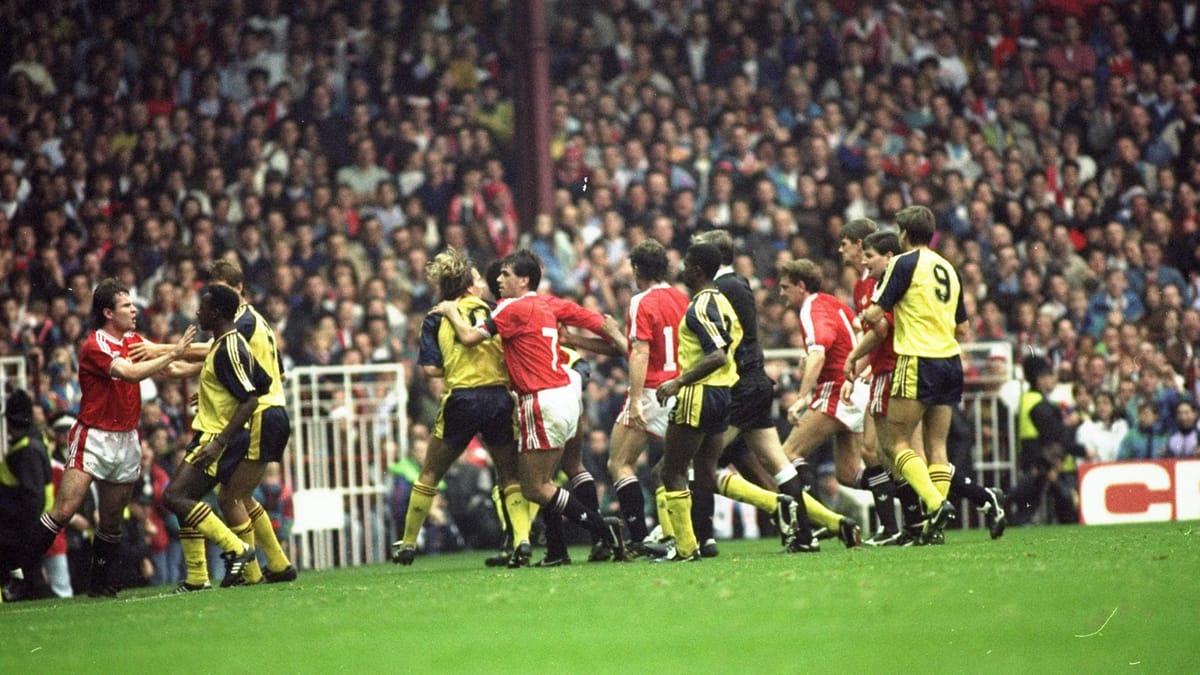
On 6 May 1991, as they celebrated Arsenal’s second league title in three years, the Highbury crowd showcased their new favourite chant. The song, to the tune of She’ll Be Coming Round The Mountain When She Comes, was ostensibly directed at the Football Association. But the entire football world was encouraged to listen.
You can stick your fucking two points up your arse
You can stick your fucking two points up your arse
You can stick your fucking two points
Stick your fucking two points
Stick your fucking two points up your arse!
The opposition for Arsenal’s party were Manchester United, which was a neat twist. A donnybrook between the two sides in the return fixture led to both having points deducted by the FA: two for Arsenal, one for United. The punishment was supposed to finish Arsenal’s title challenge; instead, it invigorated it.
That game in October became known as the Battle of Old Trafford, although technically it was the sequel after the Norman conquest of January 1987. Arsenal, despite being unbeaten, were in the slipstream of the champions Liverpool, who had won all eight league games and were six points clear. With Liverpool drawing 1-1 at Norwich, Arsenal reduced that to four with a 1-0 win over United. It came from an ingenious goal from their new Swedish signing Anders Limpar, who took a short corner, received a return pass and then caught Les Sealey out at the near post. United argued it hadn’t crossed the line; the referee Keith Hackett thought it had. Replays weren’t remotely conclusive either way, though the United manager Alex Ferguson saw something nobody else did. “The goal was a good one,” he said afterwards. “The video showed quite clearly the referee was right and the ball had crossed the line.” United’s only complaint was a moral one: Limpar’s goal, just before half-time, came spectacularly against the run of play.
Limpar was a revelation in his first few months at Highbury – a half-season wonder who added flair, class, imagination and goals to Arsenal’s team. He did things that were alien to English football – like scoring from impossible angles. “It must have been a mishit,” said Ferguson. “He was only two yards from the byline. You can’t hit a deliberate shot from there.”
Limpar did, and for a short but thrilling period it looked like he might have the kind of profound, enduring impact that Eric Cantona would later make at Manchester United.
For a delicate winger, Limpar also had a snide side. His naughty tackle in the second half started a chain of events that would lead to most of the 22 players being involved in a mass confrontation.
Until then it had been an intense, physical game, but not particularly dirty. The unlikely catalyst was a piece of skill from the United right-back Denis Irwin, a drag back that deceived Limpar and sent him sliding off in the wrong direction. An affronted Limpar bounced up and came back for more, deliberately leaving a foot in as Irwin cleared the ball. Irwin winced from the impact but play continued until, ten seconds later, Limpar was tripped by Mike Phelan. Irwin, who was nearby, booted the ball at Limpar’s head, missed and then followed through by deliberately scraping his leg under Limpar’s armpit.
Limpar bounced up to passive-aggressively offer a handshake, an offer that Irwin impolitely declined with a forceful shove. Limpar responded to that by kneeing Irwin in the thigh. “He had been needling away and getting up the noses of a number of our players,” said Ferguson in 6 Years at United. “I have got to say that he is that type of player.”
Nigel Winterburn charged in to ask Irwin, with the aid of a popular four-letter word, what he was doing. Neil Webb, United’s captain in the absence of the injured Bryan Robson, then shoved Winterburn out of the way. Eventually the referee Keith Hackett spoke to Limpar and Irwin, who pointed to the left foot that was still smarting from Limpar’s original tackle. Hackett settled for a warning rather than a booking. As they dispersed, Irwin again ignored Limpar’s offer of a handshake.
It might have petered out after that, had the players involved had chance to cool down while play continued elsewhere on the field, but serendipity played its part less than 20 seconds after the restart in the form of a poor pass from Brian McClair. His attempted header towards Irwin fell short and went to Limpar instead. He nutmegged Irwin, simultaneously hurdling a tackle that was somewhere between determined and wild.
As Limpar landed the ball hit the back of his leg and fell perfectly in between him, Irwin and Winterburn. Irwin got to the ball first and was hit by studs-up challenges from both sides. Winterburn went over the top of the ball to plant his studs into Irwin’s leg. "Let's face it, a scandalous challenge, a real leg-breaker,” said his team-mate Alan Smith in his autobiography. Limpar didn’t even bother with the pretence that he was going for the ball; his studs went straight into the fleshy part of the thigh.
Winterburn had not even hit the ground when his old friend McClair, who was on the scene attempting to redeem his poor pass, started kicking him in the back. Irwin came from the other side, hoofing a prostrate Winterburn between the legs with such zeal that he fell over. McClair kept kicking Winterburn in the back until Limpar, on his blind side, punched him round the ear. "I was involved in the tackle with Denis Irwin that started it all off but what went on after that wasn't my fault,” said Winterburn in So Paddy Got Up. “I got a couple of kicks in the back and fair play because it was competitive."
For the next 18 seconds – it felt like much longer – it was a free-for-all. Michael Thomas grabbed McClair by the throat and started squeezing. Ince chased Limpar to the touchline and threw him onto the running track in front of the advertising hoardings, one of the bits that wasn’t caught by the TV cameras.
"It was our team-mate, our little blood brother, in trouble,” said Rocastle in Proud To Say That Name. “They were kicking Nigel like it was a nightclub brawl. That's what got us upset. If it was just a bad tackle, you wouldn't go in like that, no chance. But when I saw them kicking Nigel I ran over thinking, 'You can't have this!' It epitomised Arsenal’s team spirit. We went in there and we stuck up for each other. At Arsenal we never, ever started any brawls – we just finished them."
There is poignancy in the sight of Rocastle in a bear hug, being restrained by Sealey: both died in 2001 at the age of 33 and 43.
Rocastle had been involved in a similar incident at Old Trafford three and a half years earlier. The fact there were only four survivors across both teams – Tony Adams, Paul Davis and Clayton Blackmore were the others – was a reflection of how quickly both managers had overhauled the squads they inherited in 1986. Another player involved in that game, Viv Anderson, might have been in the United corner this time but for injury.
It was painted as a 21-man brawl, the exception being David Seaman, who was 70 yards away. "I really couldn't be bothered to run all that way,” he said, “when I knew it would just be handbags at three paces.” In truth, the majority of the 21 players were trying to break it up.
The strangest thing about the brawl was that many of those who were in the mood for trouble – Limpar, Irwin and McClair in particular – were fairly laid-back characters. “Within a few minutes the red mist had disappeared and I was looking round in disbelief,” said McClair in Odd Man Out. “I couldn't believe what I'd just done. The worst thing of all was watching myself on television behaving very badly. My perceptions had been so badly distorted by rage I hadn't actually remembered what happened accurately. I was convinced that I'd only kicked Nigel once but that wasn't the case at all. Archie Knox, the coach, could hardly contain his laughter when he watched with me. ‘What the hell came over you?’ he managed to gasp out when not rendered speechless with laughter. I couldn't tell him because I honestly didn't know myself."
On the day, McClair was certain he’d be sent off. “I’ve never been sent off in my life but I’ll have to go off here,” was how he described his thoughts as Hackett walked towards him. “The referee can’t do anything else. Violent conduct, and I’ll deserve it.”
In fact, McClair wasn’t even booked. Hackett showed only two yellow cards, to Limpar and Winterburn, presumably for their original tackles on Irwin. He had tried to break things up instead of standing back and observing, which meant he could not be absolutely certain that anybody deserved to be sent off, especially as red cards in those days were a rare event.
“If I took the law as it was written, I could have sent more than four or five players off,” he said on the Football Pink. “But in reality, we didn’t have a stretcher, nobody had to go to hospital. I’m not condoning brutality, but this was passion that suddenly just tipped over.”
Hackett’s style was to give the players plenty of leeway – he was a big advocate of the advantage rule – and this was one of the occasions it backfired. “Could I have done better? Absolutely. Could I have prevented it? Yeah, but we would have had a different game – stop, stop, stop, stop.”
He did not change his attitude to letting the game flow, but he did alter how to deal with mass confrontations. Later, in his role as general manager of the Professional Game Match Officials Board, Hackett helped create a plan for how referees should deal with mass confrontations – primarily by stepping back and observing rather than trying to intervene.
There was still half an hour to go when play resumed, but both sides – perhaps surprised by the extent of their collective aggression – pretty much left it there. Limpar switched wings for a few minutes after the brawl, and the only incident of note was a high tackle by McClair on Adams that might have brought a second yellow card had Adams not made so little of it.
In the dressing-room afterwards, Arsenal’s players were high on both the result, the kind of rugged 1-0 away from home in which champions specialise, and the aggro. Limpar, in particular, was especially buoyant as he re-enacted his big moment: not the winning goal but his right hook on McClair.
“Even in the dressing-room after the game we had a good laugh about it,” says Alan Smith. “As a player it gives you a real buzz when there’s been a bit of a scuffle, especially if you’ve won the match. We found it funny then and find it funny now. Of course it got a bit more serious and we were heavily criticised, and the lads weren’t happy when the club fined them, but at the end of the season we could look back and know it hadn’t affected our title chances.”
Limpar’s memory of the incident evolved over time. “I remember Brian McClair hammered Nigel Winterburn, kicking him while he was on the floor,” he told the Guardian in 2016. “I tried to push him away and I actually hit him with my fist. That’s the thing I regret even to this day. Then the big boys joined in and Paul Ince grabbed me and he threw me into the stands.”
Both managers said the right things after the game, about studying the video and dealing with blah blah blah, though privately they were thrilled with the admittedly extreme manifestation of the team spirit both were keen to cultivate. When he joined Arsenal, Graham had a long quote from the legendary American Football coach Vince Lombardi about team spirit printed out and placed on his office desk.
It’s unlikely that any of Graham’s players read the full quote, or even the key line: “The difference between mediocrity and greatness is the feeling these players have for each other.” But they certainly got the message over the years.
Graham regularly told his players that he thought they were the only southern team who were tough enough to go toe to toe with big northern teams on their patch. “Southern teams were always called softies, but Arsenal have got rid of that,” he said in 1992, his face a picture of paternal pride.
Both Graham and Ferguson made PR gestures that they later regretted. Arsenal were effectively on probation with the FA after a similar incident at the end of a 4-3 win over Norwich 11 months earlier, and they knew a points deduction was a possibility. There had been other incidents of referee harassment – one at Aston Villa, another at Millwall made famous by a World in Action documentary – that contributed to a feeling that Arsenal were English football’s most lawless team since Don Revie’s Leeds.
That Norwich game set a precedent for the FA holding clubs responsible for the conduct of their players. It also led to the FA tightening their rules around points deduction, which were previously too ambiguous: rules 24 (a) and 26 (a, 10), since you asked. Before the start of the 1990-91 season the FA’s chief executive Graham Kelly wrote to all 92 clubs saying that points deductions could be used.
Arsenal fined five players – Limpar, Winterburn, Rocastle, Thomas and Davis - two weeks wages, around £5,000 each. Kelly privately suspected this was a PR gesture. “I suspect that maybe they forgot to deduct it from their wages,” he wrote in Sweet FA. “Who knows? But clearly it was an effort to pre-empt our decision and it failed.”
Graham suggested that Arsenal should also fine him, and did so very publicly, in the hope that such tough action would satisfy the FA. Graham was fined around £9,000 and made to sit at a press conference while Peter Hill-Wood told the world that “the name of Arsenal has been sullied” and that Graham had to be fined.
The whole thing, even the public flagellation, was Graham’s idea. He later said it "one of the biggest mistakes of my career ... I was crucified and accused of having no control over the players. I let my love for Arsenal blind me to the fact that I was putting myself up to be shot down."
Ferguson, who did not realise it was Graham’s doing, was appalled when he heard about Graham’s punishment during a League Manager’s Association dinner. “To fine and degrade their manager was a disgusting act by Arsenal,” he said. “We don’t name names at Old Trafford because we don’t want to humiliate their families and friends.”
United fined three players a week’s wages. And though they were not officially named, everyone knew the players involved were Irwin, McClair and Ince. Ferguson didn’t even confirm the fines, even though they were all over the papers. “We have taken the appropriate action,” was the extent of his public pronouncement. Unlike Arsenal, United were not particularly apologetic. But like Graham, Ferguson soon regretted making a gesture to appease the mob. “I felt embarrassed fining them because they conducted themselves with great dignity,” he said. “With a better perspective I should have just talked to them. They knew they were wrong to react to provocation and the fine served no purpose except perhaps to make the FA feel good and give the press more ammunition."
They already had plenty of ammunition from the game. "The media had a field day,” said Graham later, “reporting it as if it was the Battle of the Somme.” Others thought it was more akin to posturing outside a nightclub, the Battle of Sittingbourne High Street. Three phrases were most commonly used, depending on your view of the incident: “handbags” on one side, “brawl” – and occasionally “gang warfare” – on the other. Whatever the perception, most agreed that it was a PR disaster that punctured the optimistic mood that had surrounded English football since Italia 90.
Adams was firmly to the left of the handbag-o-meter. “The media billed it as a 21-man brawl but at least 16 were simply trying to sort it out,” he said in Addicted. “You see worse incidents over on Hackney Marshes.”
But games on Hackney Marshes aren’t shown in 64 countries. The Man Utd – Arsenal game was, with live coverage in a handful of countries and highlights everywhere else. This compounded the moral panic. On the same day, players of Derby and Manchester City had an equally zealous dust-up, with punches thrown by Adrian Heath and Mark Wright. Yet it was barely reported, never mind punished, and three decades later it would take a skilled investigator to find footage of it.
The United incident, by contrast, is still being replayed. McClair says he is "condemned to relive it constantly", because a familiar photo appears every time there is a list or feature about mass confrontations in football. "I'm right in the middle,” he said, “with a strange expression on my face."
The teams were inevitably charged with bringing the game into disrepute, and speculation began as to how they would be punished. One newspaper suggested Arsenal should be fined £1m. Another said that, had it happened in Italy, both clubs would have been relegated. And that was just in the broadsheets.
The most pious voice is usually the loudest, even if it is in a minority, and the moral panic obscured a more complex truth: that many of the fans – and the players – loved it. An FA hearing was scheduled for 12 November, just over three weeks after the incident, and the media talked dramatically about “trial by television”. Before that, an added frisson was provided by the Rumbelows Cup fourth round draw, with the two clubs drawn to face each other at Highbury on 28 November.
After a three-and-a-half-hour hearing, during which they watched three different videos of the incident, the five-man commission eventually decided to deduct two points from Arsenal and one from United, the difference being down to previous behaviour rather than an apportioning of blame for the incident. Both clubs were also fined £50,000.
“The meeting was a shambles,” said Ferguson a couple of years later, “and it’s my opinion that the decisions had been taken long before the meeting started.”
Kelly received around a thousand letters from Arsenal fans. “It took an age to reply to everyone,” he said, “painstakingly pointing out that I did not have a grudge against Arsenal.”
The deduction meant Arsenal were eight points behind the leaders and serial champions Liverpool. “The champagne will be out in Liverpool tonight,” said the Arsenal defender David O’Leary. “The FA have as good as handed them the title today.”
Graham assembled the players at the training ground in London Colney to speak to them about the media coverage, a talk that was filmed for the club’s in-house video. “The majority of the media are enjoying it, they’re enjoying us getting all this stick, because normally nothing comes out of Highbury, right? They’re enjoying it. Again, lads, there’s one way to handle it: just keep winning matches. They’re looking at us, and the stick we’ve been getting the last couple of weeks, and it seems fashionable just now to jump on the bandwagon and get into Arsenal. It’s fashionable We’re not second bottom. We’re second top of the league. It’s the best start we’ve had for over 40 years. So keep thinking football all the time. You should all be proud of yourselves.”
If that was the public version, you can imagine the private version. Graham loved to use criticism as fuel, and routinely pinned negative articles on the players’ noticeboard. Siege mentalities are inherently risky – if you don’t have the right characters, things will quickly tip over into self-pity and fatalism. But Graham – like Ferguson and Arsene Wenger at a later date – knew that he had just the right characters. Without saying as much, he borrowed a philosophy from his former club Millwall: no one likes us, we don’t care. Arsenal lost two points and stuck two fingers up to the rest of football.
“He used it to our advantage,” says Alan Smith. “We were a tight-knit group anyway with a very good team spirit, and a lot of leaders. We didn’t look back and we ended up winning the title quite comfortably.”
One man in particular was thrilled about that. “I was delighted Arsenal still won the league,” said Ferguson. “That was justice.”
They lost only one game all season, 2-1 at Chelsea in February. And there is a compelling argument that they would have gone the whole season unbeaten had Steve Bould, their player of the season by a fair distance, not gone off injured at half-time in that game. With only two subs available, the young midfielder David Hillier had to play as a makeshift centre-half.
Losing just one league game was an astonishing achievement, the only time it happened in the 20th century in the English top flight. Arsenal did not receive nearly enough credit, either at the time or subsequently. “I am sure that never in history has a championship-inning team received such a hostile press,” said Graham, “and I have to admit here that must of it was self-inflicted.”
The main reasons for that were the trouble their players had been in on and off the field and a style of play that was seen by many as offensively basic. That’s a little harsh. While Arsenal did not exactly play Total Football, to say they served up prehistoric fare is an insult to players like Davis, Paul Merson, Limpar and Smith among others. They received more credit within football, with Ferguson one of their biggest advocates. “They are worthy winners,” he said. “Christ, they’ve lost only one game in the league – when was the last time that happened, a hundred years ago? I have heard talk saying they lacked flair but with Merson, [Kevin] Campbell and Limpar there is plenty of it in the side and somebody like Davis can create.”
For all that, nobody was denying that Arsenal’s biggest strength was their remarkable defence. Seaman was a revelation in goal after joining from QPR, a controversial signing that led to the popular John Lukic being sold to Leeds. He also had the chance to go to Manchester United but spoke to his team-mate Ray Wilkins, a former United captain, who advised that he had a better chance of winning trophies straight away with Arsenal.
Seaman had to work hard to win over an Arsenal support that adored Lukic, and spent the last few games of the previous season singing that they didn’t want Seaman. There was even a protest outside Highbury. Seaman later said it was "the most pressure I have ever felt, at least as far as fans are concerned.” It was a big task but he went about it with his usual quiet excellence – no fuss, no badge-kissing, just consistently brilliant goalkeeping.
With Seaman oozing calmness and class, particularly in some difficult away games, Arsenal conceded only 18 goals in 38 games. That was despite the absence for eight games of Adams, who was jailed for four months for drink driving when he drove into a garden wall while three times over the limit on the way to a pre-season trip to Singapore. He was sentenced on the day of Arsenal’s Christmas party; the players discussed it and decided to go ahead with their session. “It’s what Tone would have wanted,” said one.
Five of the nine month sentence was suspended, and in the end Adams was released after 57 days. Ferguson was among those who wrote to Adams while he was in prison: “What I do know about footballers is that you can’t leave your character in the dressing-room. It goes out on the field with you and whatever you see of a footballer on the playing field is a true representation of his life. That being the case, Tony, you have no problems.”
Arsenal’s defensive brilliance made it even more astounding that United should wallop them 6-2 at Highbury in that Rumbelows Cup match. Wednesday 28 November 1990 was the day Margaret Thatcher resigned as prime minister after 11 years. It was an equally seismic day in the world of English football. United, who had been boring and useless for most of Ferguson’s first four years at Old Trafford, achieved a euphoric victory by playing with the kind of dizzying attacking that would later become the norm. Ferguson won his first trophy as United manager six months earlier, the FA Cup, but this was the night he located United’s G-spot and swapped Sexton football for sexy football.
Before the game, there was speculation that both sides might play with physical restraint after the events at Old Trafford. “We wouldn’t get any thanks from our fans – and there will be 6,000 of them at Highbury – for giving less than 100 per cent,” said Ferguson. “And my players wouldn’t get any thanks from me.”
As well as the sheer, exhilarating brilliance of United’s performance, there were a number of sights that would become hallmarks of his glory decades: two wingers, devastating counter-attacks – and Ferguson’s love of a surprise team selection. He omitted Webb, who had been captaining the team in the absence of the injured Robson, and brought in Lee Sharpe. He also had the inspired idea to put the 5ft 4ins Danny Wallace, who had flattered to deceive on the wing since joining from Southampton the previous season, up front against the twin towers of Bould and Adams. For one night only, Wallace – truly – played like the Brazilian genius Romario, slithering like a lizard between Arsenal’s giant centre-backs. He scored one and made four. And he wasn’t even the Man of the Match.
Lee Sharpe’s life changed on 28 November 1990. He scored a glorious hat-trick, including a stunning right-footed curler put United 3-0 up just before half-time. Arsenal fought back to 3-2 before being picked off devastatingly on the break with three goals in seven minutes, including two more from Sharpe. Oddly for such an unashamedly one-footed player, none of the goals came with his left foot. The chances were such that the match could feasibly have ended 12-7 to United, and the actual score was Arsenal’s heaviest defeat at home in 70 years. “David Seaman let in six goals yet he had an outstanding game,” said George Graham. “I felt that he gave an England performance.”
Sharpe’s performance put him on England’s radar. He made his debut four months later and for the rest of the season he was nigh-on unplayable. His fresh face, good looks and shiny, happy nature made him arguably British football’s first pop star since George Best. This was not entirely to Ferguson’s taste. He had been on Sharpe’s back even in the days after the 6-2 win. He slaughtered Sharpe privately – “I don’t know who the fucking hell you think you are! Get your feet back on the floor!” - for doing an interview with the press the day after the game and posing with three top hats on his head; then he slaughtered him publicly, on the team coach, three days later when Sharpe scored the winning goal at Everton and celebrated with the dance that would become known as the Sharpey Shuffle. “Who the fucking hell do you think you are? Fucking stupid dancing, what the fuck do you think you’re doing? If I see you doing that again you’ll be out of this club.”
Their relationship never truly recovered. “Something cracked between me and the manager that day, on that coach,” said Sharpe. “He certainly wasn’t my father figure any more, and I wasn’t his blue-eyed boy. Ridiculous, over such petty things, when I was delivering him phenomenal performances … He stamped on the greatest week of my life.”
Arsenal were becoming experts in turning adversity into fuel. Four days after that humiliation against United, they hosted unbeaten Liverpool, who led by six points, in a live televised game. Graham was desperate to rationalise the United game as a complete freak, and he had just the precedent. He reminded the players – and the media – that even the famous Double-winning side of 1971 had lost 5-0 at Stoke. Graham went back to a sweeper system to add a bit of insurance; the Liverpool manager Kenny Dalglish picked a bizarre team that included four full-backs. Arsenal routed them 3-0. "Now that,” said Graham, “is what you call resilience.”
They slowly reeled Liverpool in, and went top of the table on 19 January. They stayed there for all bar one week for the rest of the season. Dalglish’s resignation in February, shocking as it was, was a red herring: the force was emphatically with Arsenal. A 1-0 win at Anfield in early March completed a symbolic league double over Liverpool, Arsenal’s first for 15 years. And though they were a number of draws during the run-in, Arsenal always looked more convincing than an erratic Liverpool. They were strong favourites to do the Double until they were ambushed by Paul Gascoigne in a famous FA Cup semi-final defeat to Spurs at Wembley.
Arsenal were confirmed as champions just before their penultimate match, when Liverpool lost 2-1 at Nottingham Forest on May Bank Holiday Monday. That game kicked off at 5pm, so that it could be shown on ITV. Arsenal’s game against Manchester United would then also be shown live, but only if the championship was still at stake. The kick-off time was moved to 8.05pm to avoid a clash with Coronation Street . It turned into a celebration even before the kick-off. Some of the players savoured their triumph with a pre-match bottle of Lucozade that contained something other than isotonic carbohydrate-electrolytes .
Arsenal won easily, 3-1, with Smith scoring a hat-trick. He completed it with an emphatic penalty, given to him by the usual taker Lee Dixon. Smith was not usually a fan of taking penalties, but this was the perfect storm: he was on a hat-trick, Arsenal were 2-0 up in a game they didn’t need to win anyway, and he needed every goal he could get in the fight for the Golden Boot. In the end it proved decisive; another goal on the final day of the season gave Smith 22 for the season, one ahead of Lee Chapman and two ahead of Niall Quinn and John Fashanu.
A row between ITV and the Football League, who were irritated that they didn’t receive more money for ITV’s proposal to televise two games in one day, meant that the league trophy was not at Highbury. Tony Adams was given a poundstore substitute instead, and Arsenal had to wait until their final game – a 6-1 thrashing of Coventry – to lift the real thing. It felt appropriate for a season in which Arsenal had triumphed despite a thousand slights and setbacks. When they sang their new favourite song during the United game, it was done with feeling, as Nick Hornby wrote in Fever Pitch:
‘You can stick your fucking two points up your arse,’ the crowd sang gleefully, over and over again, throughout the Manchester United game, and it began to seem like the quintessential Arsenal song: take our points, imprison our captain, hate our football, sod the lot of you. It was our night, a show of solidarity and defiance that had no grey areas of vicarious pleasure for anyone else, an acclamation of the virtues of all things unvirtuous. Arsenal aren’t a Nottingham Forest or a West Ham or even a Liverpool, a team that inspires affection or admiration in other football fans; we share our pleasures with nobody but ourselves.”
There were a few choruses of Two Points in the dressing-room that night as well. United lined up to applaud Arsenal onto the field, and before the game McClair – who missed the birth of his son to play in the match – approached Winterburn and suggested the two should make peace.
There will still a soupcon of needle when Limpar’s studs cut open Robson’s left Achilles with a not entirely chivalrous tackle. It was the same injury that had ended his World Cup the previous summer. With the Cup Winners’ Cup final against Barcelona only nine days away, it looked like Robson might miss his first ever European final. He was both fuming and disconsolate as he left the field, chuntering to everyone and no one as he walked straight down the tunnel. His face suggested he thought he would miss the final.
Instead he gave what he regards as the best performance of his career in United’s memorable 2-1 win over Johan Cruyff’s side. At that stage United were still emphatically a cup side. They had finished sixth in the league, 24 points behind Arsenal. But when Ferguson awoke in Rotterdam, flushed with European success, he couldn’t help himself. “Now,” he said, “I want to have a real go at the league.”