5. The perch
So who did knock Liverpool off it?
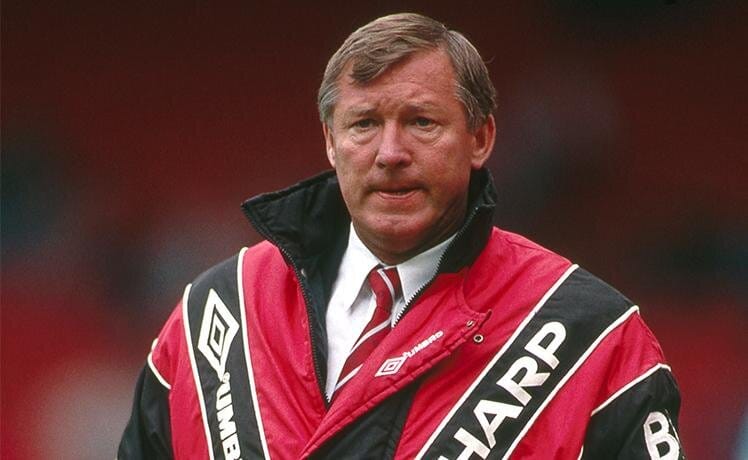
In September 2002, Alex Ferguson was a media punchbag. Manchester United were eighth in the table after their worst start to a Premier League season. Arsenal were the nation’s darlings and plenty of usually good judges thought Ferguson was past it. In his Daily Telegraph column, the former Liverpool defender Alan Hansen said Ferguson was facing “the greatest challenge of his career”.
You didn’t need a degree in Fergie to know what this comment would do to his temperature, especially as it came from a former Liverpool player. "My greatest challenge is not what's happening at the moment," he said. “My greatest challenge was knocking Liverpool right off their fucking perch. And you can print that."
Liverpool’s perch slowly became part of the football lexicon, and the legend grew that Ferguson had knocked them right fucking off it. But it was not a popular view in the Gunners pub or the Highbury Barn. The people there argued that Arsenal’s titles in 1989 and 1991 were symbolic moments in the end of Liverpool’s 20-year dominance of English football, and that if anyone knocked Liverpool off their perch, it was George Graham.
“I don’t know whether it is because many people seem to be unable to remember events before the Premiership era began, but history seems to have been rewritten,” said Anders Limpar in Highbury. “Alex Ferguson and Manchester United seem to be taking the credit for ending Liverpool’s dominance. Correct me if I’m wrong, but wasn’t it Arsenal who beat Liverpool at Anfield in 1989 and then won the title against in 1991. Even Leeds won the title before United got it in 1993. I suppose it doesn’t matter too much any more, but it was Arsenal who broke Liverpool’s stranglehold.”
There is also an argument that any or all of the following made Liverpool unsteady on their perch: the Hillsborough disaster, Steve Coppell, Kenny Dalglish and Graeme Souness. But what nobody would dispute is that Ferguson clambered atop the perch that Liverpool vacated and stayed there for the next two decades, doing a silly little jig of triumph. The 1991-92 season was when United became serious contenders for the title, just as Ferguson said in the giddy aftermath of Rotterdam. They didn’t win it – Leeds pipped them when a weary United fell at the final hurdle – but they challenged for the first time under Ferguson. In the 24 years since United last won the title, in 1966-67, they had finished second only twice. From 1991-92, they finished in the top two in each of the next 10 seasons, and they were never out of the top three until Ferguson retired in 2013.
Ferguson was wrong about one thing, though. In the summer of 1991, he thought that he, Graham and Souness would be fighting for the league in the next few seasons. “I don’t mind if it becomes a battle of the Scottish managers,” he said, “as long as United end up on top.”
In fact, Arsenal and Liverpool would never again challenge for the title under those managers. Souness’s well-intentioned but heavy-handed attempts to modernise Liverpool created major problems, eventually leading to his resignation in 1994, while Graham’s Arsenal surprisingly failed to build on their emphatic title win of 1990-91.
That was despite (some would say because of) the signing of the talismanic Ian Wright in September 1991. As Arsenal became a cup team, United went in the other direction. They won the Premier League in style in 1993, ending a 26-year wait, and followed up with two Doubles in 1994 and 1996. Their title rivals in the five seasons from 1991-96 were not Arsenal and Liverpool but Leeds, Aston Villa, Blackburn and Newcastle.
Arsenal came 4th, 10th, 4th, 12th and 5th – but even those slightly underwhelming finishes flatter them. The first week of their title defence in 1991-92 set the tone for the first half of the decade, never mind the new season. They scrambled a 1-1 draw at home to QPR, thanks to a very late goal from Paul Merson, and were then well beaten at Everton and Aston Villa. They lost more games in the first eight days than throughout the 1990-91 season.
For the next few years, Arsenal’s seasons followed a similar pattern: a false start, a partial recovery, a thoroughly bleak winter and then a strong finish to the season – either in the league, the cups or both. Those strong finishes, along with the residual respect from their title wins in 1989 and 1991, led to them being among the favourites again at the start of the following season.
It was there, in plain sight, that they had evolved into a cup side, but it took four or five years for everyone to realise. Ferguson’s admiration for Arsenal was such that he was one of the last to twig. He regularly tipped them as United’s main challengers at the start of the season. Before the start of the all new Premier League in 1992, Ferguson rated every team in the Sunday Mirror.
“The official favourites - and with good reason - are Arsenal. They have more firepower than any other club. Kevin Campbell can only get better and Ian Wright was a sensation after joining last season. And with Paul Merson, Anders Limpar and Alan Smith, too, they have a lot of ammunition. They also have continuity at the back. They will be there or thereabouts next May.”
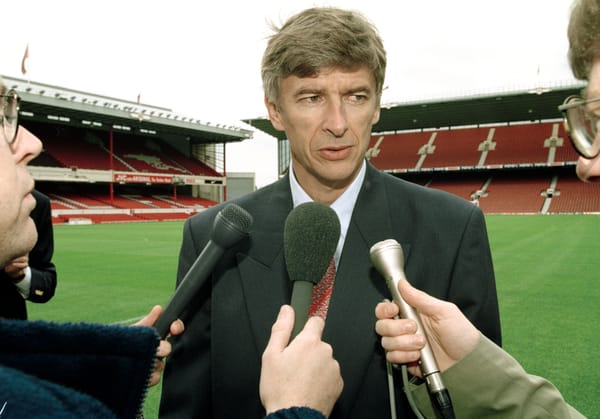
Ferguson’s views were widely shared, given that Arsenal had been the top scorers in the league the previous season. But they finished 10th and were the Premier League’s lowest scorers, with 40 goals in 42 games. What could have been a desperate season became a triumphant one when they won both the FA Cup and League Cup. It was a major, unprecedented achievement at a time when those competitions had not been devalued, and led to them being installed again among the favourites for the league the following season. “At the start of any season,” said Ferguson in August 1993, “you say to yourself if you finish above Arsenal, that will do.” By the time Ferguson and the rest of football realised Arsenal weren’t a threat, Arsene Wenger was about make them contenders again.
In the first four seasons of the Premier League, Arsenal v United was a relatively low-profile game. It was televised only once, the same as Swindon v Coventry and Middlesbrough v Oldham. The biggest match of the Premier League’s early years, Blackburn v Manchester United, was shown six times. The couch potatoes didn’t miss that much, just a series of low-scoring, sometimes crotchety encounters with occasional moments of brilliance. “The way the play the game, pushing up, condensing the game, playing offside, pressurising the referee and linesmen for offside decisions, meant it is never a pretty game with them,” said Ferguson in 1994.
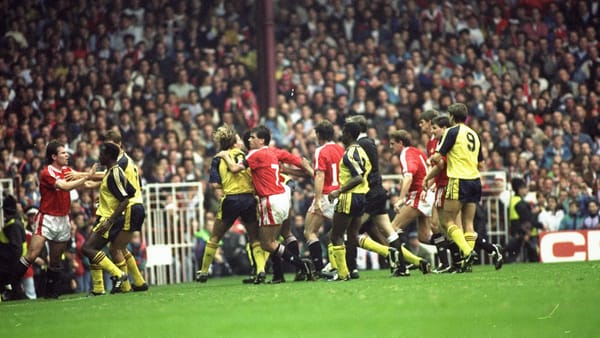
While there was nothing like the free-for-alls in 1987 and 1990, there was a physical intensity not seen in many other fixtures. “They had big characters in their team and they were physically strong, so they wouldn’t back down and nor would we,” says Alan Smith. “I think that’s what led to a bit of argy-bargy.”
That cast of characters continued to evolve. When the teams met at Old Trafford in October 1991, 17-year-old Ryan Giggs made the first of his 50 appearances against Arsenal. He hit the post early on and was overshadowed by a veteran of the fixture – 24-year-old David Rocastle, who gave Arsenal the lead with a glorious goal. Rocastle, enjoying a brief resurgence in a new central-midfield role, produced a 10-second showreel of everything that made him so popular: tenacity, skill, courage, imagination and charm. He danced past Paul Ince and Bryan Robson before floating a long-range chip that hit the bar, rebounded onto Peter Schmeichel and back into the net.
In the Premier League era, the Dubious Goals Panel would have given it as a Schmeichel own goal. After the game Ferguson called it “a brilliant piece of imagination and improvisation”. Even Schmeichel, who saw being chipped as an affront to his masculinity, said it was a “great goal”.
That match was the first time in years, arguably decades, when Arsenal and United met as credible title contenders. It was a rugged, almost cliched arm-wrestle between emerging contenders and established champions. The match ended in a 1-1 draw after Steve Bruce equalised with the back of his neck, having ducked too low as he stooped to head a Giggs cross.
In a blood-and-thunder game – Ian Wright, playing against United for the first time as an Arsenal player, might have been sent off – the main moments of class came from Rocastle and Neil Webb in central midfield. There was talk of them playing together for England, but that never happened. Life moves pretty fast: within 14 months both had been sold to Leeds and Forest respectively.
Rocastle’s final goal for Arsenal came in the return fixture, a low-key 1-1 draw at Highbury in February. Arsenal went into the match in dreadful form, still reeling from an FA Cup humiliation at Wrexham, but Rocastle’s goal – which equalised an earlier strike from Brian McClair – sparked an unbeaten run until the end of the season.
At the end of the season, Graham sold Rocastle with the heaviest heart. “When he was at his peak and before knee problems started to take the edge off his game,” he said, “David was as good as any midfield player in the land.”
The new focus of matches between Arsenal and United was a player who left Leeds rather than joined them: Eric Cantona, whose move to Manchester United in November 1992 was so shocking as to be a JFK moment. For the next few years, Cantona’s personality dominated their matches against Arsenal, for good and bad, and sometimes even when he wasn’t playing.
The first Premier League meeting between the sides, a 1-0 win for United at Highbury, is best remembered for the sight of Cantona sitting in the directors box wearing a pastel rollneck sweater and woollen overcoat. United, who signed him the previous day, had not registered him in time for the fixture. The match, which was decided when Mark Hughes humped and possibly handled the ball over the line from a yard out, was almost a backdrop to excitable discussions about whether Ferguson had pulled off a masterstroke or taken one gamble too many.
Ferguson felt Cantona’s presence in the stand sharpened a team that has started the season anaemically. Indeed, United and Arsenal were bottom of the first published Premier League table, having both lost their first two games of the season. United fumbled for much of the autumn, but the authority and style of their 1-0 win at Highbury made Ferguson feel, for the first time, that they were capable of winning the title that season. He was right, though even he must have been surprised by the extent of United’s improvement after they signed Cantona. In 1992 United played 37 league games before Cantona, collecting 54 points and scoring a miserable 38 goals. In the next 37 league games they took 88 points and scored 77 goals. Faites des maths.
United’s only blip in the remainder of the season came in March 1993, when they went four games without a win amid talk that they would bottle the league for the second year in a row. The last of those was a nervous 0-0 draw against Arsenal at Old Trafford in March. United had most of the possession but Arsenal, ninth in the table and long since out of the title race, should have won. Schmeichel made a spectacular save from Campbell, flying to palm the ball away as Campbell tried to chest it round him; Wright shot too close to Schmeichel after beating four players during a thrilling run; and then Merson, who was playing some of the best football of his career, hit the bar with a huge up-and-under from 30 yards.
Ferguson had been heavily criticised for his edgy demeanour during United’s collapse the previous season. This time, whether because he trusted his players or he was a very good actor, he radiated calm. (He has always said it was the former, and that he felt a sense of destiny throughout the run-in.) On the same night, the other two title challengers met at Carrow Road, with Norwich beating Aston Villa 1-0. “I think we have a very good chance, but so do Norwich now and so do Aston Villa,” said Ferguson. “It’s all interesting stuff,” he continued, breaking into a smile, “and I wouldn’t put a penny on anyone the noo”
Ferguson’s relaxed demeanour was one of the reasons United won all their remaining seven matches, and with it the league, and they were in fine mood when they went to Highbury for David O’Leary’s testimonial at the end of the season. With no Norman Whiteside around to remind O’Leary of the old days, a jovial match ended in a 4-4 draw. Schmeichel even played part of the game as an outfield player. Arsenal, who had drawn the FA Cup final with Sheffield Wednesday two days earlier and would win the replay three days later through Andy Linighan’s injury-time header, felt safe enough to use all their first-team players.
Both league games had been bloodless, and now Arsenal and United had taken part in a festival of goodwill. There was a serious danger of peace breaking out between the sides. And then United signed Roy Keane.