6: Anyone But United
In 1993-94, Manchester United stole Arsenal’s title as the most hated team in England
The acknowledgements at the front of Roy Keane’s first autobiography, published in 2002, are brief and to the point. Eleven lines of businesslike appreciation of those who edited, transcribed and ghost-wrote, who “helped me tell my story”. The person he thanks last is his agent. “And of course for so much, so generously given, to Michael Kennedy. Pity he’s an Arsenal fan.”
Keane’s hatred of Arsenal defined his Manchester United career. He was indelibly associated with them, and in particular Patrick Vieira. As well as all the iconic moments, in tunnels and even on football fields, various important career landmarks involved Arsenal. Keane made his United debut against Arsenal and played against them more than any other club in his 12-and-a-half years at United. If you count penalty shoot-outs, which is exactly what we’re going to do to fit our preferred narrative, he scored his first and last goals for United against them. Most symbolically, he captained United for the first time at Highbury in 1997. And Arsenal are surely the only club that could prompt a rare foray into the world of banter in the acknowledgements of an autobiography.
His disregard for Arsenal preceded his move to United. Keane grew up in Cork as a Spurs fan, idolising Glenn Hoddle, and during his time at Nottingham Forest he was almost arrested at Highbury. In April 1993, Keane continued his demented one-man mission to keep Forest in the Premier League by scoring a 94th-minute equaliser against Arsenal. He was already in the bad books of the home fans after putting Nigel Winterburn on a stretcher earlier in the game, and his overzealous celebration of the goal led to a visit from Uncle Plod on the team coach after the game. Keane was taken back to the dressing-room for questioning.
“Keane allegedly lifted his shirt, kissed it and made abusive comments to the crowd,” said Inspector Daniel Keogh. ''The matter has been passed on to the match referee who has indicated he will report the incident to the FA.”
In the end no action was taken, but it was the continuation of a headline-grabbing season for Keane on and off the field: he was sent home from a club trip to Jersey, and fined a week’s wages, after brawling with a man whose wife had poured a gin and tonic over his head. (Keane reciprocated, serenely pouring his drink over hers, at which point the husband intervened and fists became active.)
In the week of the Arsenal game he was sued for defamation by an ex-girlfriend from Cork, who claimed £15,000 damages after he allegedly called told her to “Shut up, you whore” and “suck me, bitch” outside a nightclub a couple of years earlier. The case was eventually heard in 1995, when a judge decided the comments – Keane admitted the first but denied the second – were not defamatory.
On the field he was largely magnificent, and his refusal to accept the bleedin’ obvious - that Forest were going down – drew admiration from all quarters: he was included in the PFA Team of the Year, the first player since Trevor Brooking 15 years earlier to do so when his team were relegated, and was voted Player of the Year by Forest fans.
The police may have let him off, but Keane was England’s most wanted in a different sense. As well as interest from all of England’s biggest clubs, he was linked with Real Madrid and Sevilla, who were keen to put him alongside Diego Maradona. Keane had impressed Maradona during a World Cup qualifier against Spain in Seville the previous November.
Keane eventually decided to join United, despite shaking hands on a deal with Blackburn manager Kenny Dalglish. At first it seemed Blackburn’s financial clout would swing the deal. For most of his three years at Forest, Keane was on £700 a week. That was increased to £5,000 in March 1993 after Clough found out he was overdrawn. Blackburn offered twice that, but Ferguson charmed Keane over a game of snooker at his home.
Arsenal were also interested, but Keane turned his nose up at their approach. “Forest have informed me that Arsenal want to see me,” he said. “But I’m 90 per cent sure of what club I want to join.” (Arsenal did sign a Republic of Ireland midfielder that summer. Eddie McGoldrick wasn’t quite what their fans had in mind.)
Keane announced he wanted to go Old Trafford and then waited while the two clubs agreed a deal. “Keane’s done himself no harm by stating that he wants to come to United,” said Ferguson. “It shows he's got ambition. I'm delighted with that type of attitude.”
Keane was far from the only reason why Arsenal and United remained one of the Premier League’s livelier fixtures, but he played an inimitable part in re-establishing bad relations. His first game for United was a pre-season friendly against Arsenal in South Africa in 1993. Keane almost had a fight with Martin Keown, who had rejoined Arsenal a few months earlier, and the Independent said he “made a thoroughly undistinguished debut”.
The match descended close to anarchy, mainly because of a performance from the referee, an Irish ex-pat called Errol Sweeney who revelled in the nickname of “The Hanging Judge”, that could generously be described as erratic. He gave two extremely dodgy penalties against Steve Bruce, one for an obviously accidental handball, both converted by Ian Wright, and then ignored an identical appeal for handball at the other end. Denis Irwin pushed him, and then Bryan Robson snapped and called him “a fucking cheat”. Sweeney sent Robson off.
Robson was even more surprised, when, after the game, the same referee cheerily asked if he could have a picture taken of the two of them. Robson, still fuming, told him where he could stick his Kodak moment. That’s Robson’s version, anyway; Sweeney denies the whole thing. But thirty years later, he is still dining out on the day he sent Robson off.
Keane, who had been signed as Robson’s long-term replacement, also stepped into his drinking boots. At that stage he was a 22-year-old who could drink for Britain and Ireland, and fondly recalled some “spectacular sessions” on that first trip to South Africa. One of them came within spitting distance of a punch-up between United and Arsenal players. On a night off, some of the United squad went into the same bar as the Arsenal team, who were already well into their work. Robson noticed Paul Merson flicking spit onto the back of a girl, who was oblivious to what was happening.
Robson, 36, was entirely unimpressed by this display of modern humour. As Merson, Tony Adams and Ray Parlour sniggered, Robson told them they were out of order and not to do it again. A couple of minutes later, Merson did do it again, at which point Robson intervened more firmly. “Next time you do that,” he said, “I’ll knock your lights out.” Merson’s saliva glands dried up after that.
Despite the occasional tension between the players, Graham and Ferguson had a solid relationship. They were proof that you can recover from a dodgy first impression: after almost coming to blows during their first meeting in 1987, they became great friends. “George Graham was a bit of a mentor for Alex Ferguson back then,” says Alan Smith. “He was at a big club and he was achieving success. They were good pals and George offered him bits of advice. I think Alex would ask him about money as well. It seems strange looking back, but that’s how it was.”
After one visit to Old Trafford, the Arsenal players scrambled to make it back to the team coach by the designated time. They knew that, under Graham, anyone who was late would be in bother. As the deadline passed and the coach stayed defiantly still, the players looked around trying to work out who was late and thus for the high jump. Then, to their surprise, Graham appeared, apparently refreshed after a post-match drink in Ferguson’s office. “He got on the coach,” said Ray Parlour, “and he couldn’t even walk up the stairs!”
Ferguson owed Graham a few glasses of premium liquor. In the summer of 1993, when he had won his first Premier League title, Ferguson asked the United board for a payrise. He was unhappy that United’s best-paid player, Cantona, was earning almost three times as much as he was. Ferguson, who was reportedly on around £4,000 a week, also knew that many managers earned more. To support his case, Graham gave Ferguson a copy of his Arsenal contract, which showed he earned more than twice as much. Martin Edwards, the United chairman, did not believe the contract was real and called his opposite number at Arsenal, David Dein, who denied Graham was being paid that much. “It was a farce,” said Ferguson in My Autobiography. “Had it not been for Maurice [Watkins] and Roland Smith, I would have left the that day. I was close to leaving anyway.”
Ferguson did get a payrise, though nothing like the one he wanted. He had more luck when it came to buying players. While he broke United’s wage structure to sign Cantona, Graham was bound by Arsenal’s. “More than once,” he said, “I made the point to the directors that Manchester United, in particular, were getting the players I wanted because I could not compete with the wages being offered by other clubs.”
Graham only discussed this after he had left Arsenal, so at the time most supporters thought he was biting off his nose to spite his midfield. Graham had slowly stripped his team of flair – he sold Michael Thomas in 1991, David Rocastle in 1992 and Anders Limpar in 1994, while an ageing Paul Davis was marginalised. Graham sold Thomas and Limpar because he felt their work-rate had dropped below acceptable levels. The players he replaced met that criteria; trouble was they didn’t come close to Thomas and particularly Limpar’s creativity.
Instead the Arsenal midfield became full of blue-collar workers like John Jensen, who was signed in 1992, and homegrown products like David Hillier, Ian Selley and Steve Morrow. In his book, the Glory and the Grief, Graham lists the players he wanted to sign but couldn’t: Keane, Paul Parker, Chris Sutton, Tony Cottee, Jan Wouters, Didier Deschamps and David Ginola.
Arsenal became more one-dimensional, dangerously reliant on the unorthodox brilliance of Ian Wright. They still had one of the best defences in the world, and Wright had a unique capacity to abracadbra goals. It was an enviable model for one-off cup games but proved unsustainable over a whole league season. The paradox is that, in signing one of Britain’s most brilliant strikers, Arsenal became a more defensive team. Many Arsenal fans think that another event in the autumn of 1991 was the reason for that: the chastening European Cup defeat at home to Benfica, which bruised Graham and made him even less inclined to drop his guard tactically.
There were spells when Arsenal played some blistering stuff, particularly during a spectacular finish to the 1991-92 season that brought 26 goals in the last seven home games. That was sparked by an extraordinary 7-1 win over title-chasing Sheffield Wednesday. Having scored six goals in the previous 16 hours, Arsenal then scored six in 19 minutes. But for the most part they were hard to watch and harrowing to play against. Some would say it was the other way round.
“Boring Boring Arsenal” became an increasingly popular chant among opposition fans, United’s included. As the Arsenal players walked up the Wembley steps to receive their medals after the 1993 Charity Shield, they were serenaded with it.
That match had ended in a 1-1 draw. Mark Hughes gave United the lead with an acrobatic volley; Wright equalised with an even more spectacular snapshot. “Och, how does he do it?” exclaimed Sky Sports’ Martin Tyler. “How does he do it?”
It was the first of 35 goals for Wright that season, the most productive of his career. It’s hard to believe that any player in football history has experienced a greater buzz when scoring a goal, and his unfettered, unscripted celebrations were all part of the package. "It is not just a goal when Ian scores – it's an occasion,” said Graham in Glory and the Grief. “Nobody salutes a goal quite like Wrighty." On this occasion he settled for jumping into the arms of Paul Merson and raising his left arm in triumph.
The Charity Shield had previously been shared when the match ended in a draw; this time, a penalty shoot-out was introduced, though Graham didn’t know about it until he got to the ground. It was not the most nerve-shredding of events, Keane celebrated his goal with a smile and an Iberian slap in the general direction of the Arsenal supporters. Wright smiled after missing a kick to win the match, and Seaman then strolled forward to take Arsenal’s penalty in sudden death. It was saved by Schmeichel and that was that. The decision to end the match with a penalty shoot-out was seen almost as an act of cultural vandalism, and the Times said that the sight of Seaman taking a penalty “turned the denouement perilously close to farce”.
The teams met again in the league at Old Trafford a month later. Both had started the season strongly, with Arsenal recovering from an absurd 3-0 defeat at home to Coventry on the opening day of the season. It was first v second and live on Sky.
Jensen set the tone for an unyielding afternoon by putting Sharpe up in the air after 16 seconds. Keane was booked for scraping his studs across the knee of Keown, who later received a yellow card for hoofing the ball away in frustration and almost hitting a linesman. Bruce was off the field for almost eight minutes after a clash of heads with Kevin Campbell caused a grisly cut, and played the last hour with his head bandaged.
Campbell was blameless in that incident, but even Ferguson said that Hughes was lucky not to be sent off towards the end of the game after an off-the-ball incident with Davis. It wasn’t properly caught by the cameras, but the sight of a groggy Davis being given smelling salts didn’t ask too much of the imagination.
Andy Linighan might also have walked for fouling Eric Cantona when he was the last man. The referee didn’t give a free-kick; had he done so, Linighan would have been sent off.
There was some football as well. United won 1-0 thanks to a violent free-kick from Cantona. After a soft foul was given against Hillier 25 yards from goal, Paul Ince tapped the ball gently to his right. Cantona – who never really took free-kicks - strolled onto the ball and blistered it into the top corner. A smiling Ferguson puffed his cheeks, looked across and introduced a new word – a combination of ‘och’ and phwoar’ – to the English language.
Cantona’s goal and the playful effervescence of Giggs, still only 19, reflected United’s slight but undeniable superiority. Arsenal had set up with an unusual man-to-man marking system and Giggs, who started on the right wing, was followed everywhere by Nigel Winterburn. Before the match, Winterburn told Giggs he would kick his lights out if he tried to go past him. Giggs’ delayed response, late in the first half, was a piece of skill that was a staple of montages for the next 20 years.
Later, Giggs discussed it with Jim White in the book Are you Watching Liverpool. “Sometimes,” he said, “you’ve got to take the piss.”
That aside it was a frantic, scruffy game. United missed the better chances, though they had to make a few desperate defensive blocks at the other end. Ferguson was thrilled with the victory. “It stretched the lead between us and the Arsenal, and that was special to me,” he said at the end of the season. “I always look upon Arsenal as the one you’ve gotta beat, and they probably say the same about us.”
Arsenal’s title challenge fell away rapidly after that defeat, and in October they almost went beyond parody by drawing all four league games 0-0. They could not match United for style or substance. Ferguson’s team built up a huge lead, all the while playing some of the most dynamic football ever seen in England, never mind Manchester. By January, with United miles clear, Graham was again left trying to explain what had happened to the team that won two titles in three seasons. “The difference between them and us is that their midfield players are better than ours,” he said in an interview with the Independent. “I still think Cantona will let you down at the very highest level. I think he let Leeds down last year against Rangers, twice, and in the big games, against Inter Milan or whoever, I think Cantona will go missing. He's a cry baby when the going gets tough.'
Graham apologised to Ferguson and – you guessed it – said he had been misquoted. By the time United met Arsenal again at Highbury in late March., the going was getting extremely tough. United were looking nervously over their shoulder at a rampant Blackburn. Public attitudes towards United had hardened, primarily because of their on-field aggression, and three days earlier Cantona was sent off for stamping on the chest of Swindon’s John Moncur. Not even Ferguson tried to defend him that time.
Arsenal, who were enjoying their usual spring resurgence, were in the mood to show they were still relevant. They had not lost in the league for over three months and were also high on a memorable Cup Winners’ Cup run that had taken them to the semi-finals. While league points were unimportant, the game against United was a chance to flaunt their good form and put down a marker for the following season.
The upshot was a pulsating 2-2 draw, played at almost demented speed and with an overload of skill and steel. It was the sort of game that could only take place under the lights. Lee Sharpe, playing his first game of 1994, scored both United’s goals. Ferguson knew Sharpe wasn’t fully fit but picked him because of his record at Highbury and told him to save his energy and ration his defending. What Ferguson didn’t know was that Sharpe spent the night before the match having a spliff with his girlfriend.
Paul Merson, who at the time was struggling with addiction to a more dangerous drug, cocaine, was still somehow able to play some of the best football of his career. He set up Arsenal’s first equaliser with a wicked free-kick that was sliced into his own net by Gary Pallister, and scored their second equaliser 12 minutes from time with a savage finish. United were fuming that the referee Vic Callow unwittingly baulked Irwin, who might otherwise have been able to tackle Merson. “He played a very important for Arsenal that night, the referee!” chirped Ferguson in an end-of-season video.
An enraptured crowd of 36,203 included Arsenal supporter Osama bin Laden, who was in London on al-Qaeda business but found time to watch three games at Highbury.
Some of the football played by both times was mesmerising. Merson and Wright were full of imagination and menace; Cantona floated around, bringing order and a lightness of touch to the maelstrom; and Giggs went on a series of devastatingly incisive high-speed runs. Though he had greater moments against Arsenal, one in particular, he may never have played better across a full match.
The match was dirty without, by the standards of the day, being especially bad-tempered. Keane was spoken to three times before being booked in the 22nd minute for kicking Davis in retaliation. But most of the bad tackles were reckless rather than malevolent, made to look worse by the frantic nature of the game. “Full of commitment, blood-thundering (sic) tackles all over the place,” said Ferguson. “It marked down the prestige that both Arsenal and Manchester United have at the moment in English football.”
Irwin was lucky not to be at least booked for scraping his studs across Alan Smith’s knee, a tackle almost identical to the infamous one on him by Feyenoord’s Paul Bosvelt three and a half years later. For a split-second it looked like Smith’s knee was about to buckle. It feels highly unlikely that Irwin was trying to do Smith, but it was comfortably the most dangerous tackle of the game.
All that became prologue when the game exploded in the last five minutes. In the 86th minute, Cantona was booked for a flying two-footed tackle on Ian Selley. It looks grim to modern eyes, a straight red in any currency, though at the time such challenges were not a particularly big deal. Hughes said Selley made a meal of the challenge, and in 1994 that wasn’t an outlandish view. Thirty years later, it looks like Cantona almost made a meal of Selley.
Wright then had a winning goal disallowed for a non-existent foul by Smith on Schmeichel, which extended his frustrating run without a league goal against United. It also saved Schmeichel from scrutiny – he was embarking on one of the worst spells of his United career, with a series of errors that threatened to undermine their attempt to win the Double. As heretical as it sounds with hindsight, many of United’s hardcore support were not against selling him.
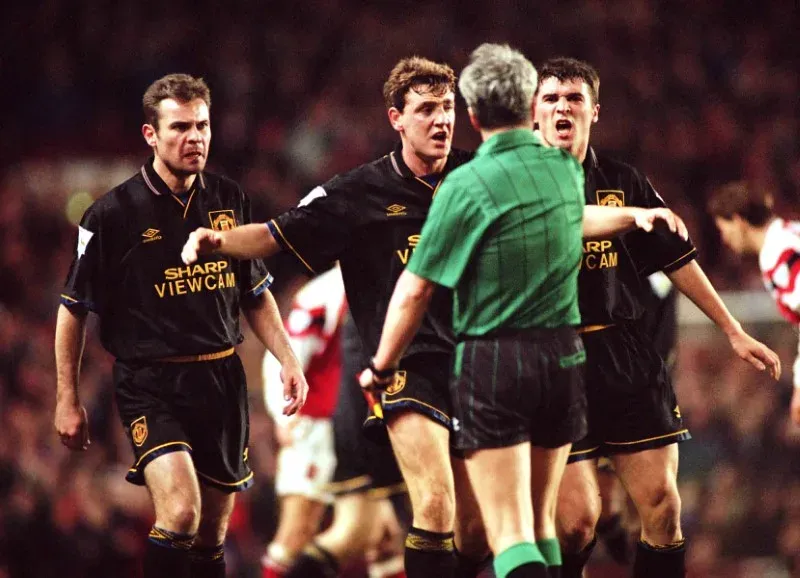
And then it happened. Cantona won the ball off Jensen and moved towards a follow-up tackle with Adams on the halfway line. As he realised they were going to collide, Cantona tried to jump out of the way but instead jumped into Adams. Not even the most rabid Arsenal fan appealed for a foul, yet Vic Callow immediately whipped out the red card. It was a ludicrous decision, and the United players did not take it with equanimity. They chased and snarled at Callow, an understandable response yet one that exacerbated the perception of lawlessness around the team.
Keane repeatedly barked “Have a word!” at the nearest linesman, an echo of Ron Atkinson’s complaint when Remi Moses was sent off on the same ground 11 years earlier.
Cantona’s red card was United’s first against Arsenal since Moses, and the first in this fixture since Rocastle in 1987. In those seven years, there had probably been 20 more deserving cases. “It's not often I lose my temper,” said Bruce. “But the referee didn't do his job because Eric was only trying to get himself out of the way of the challenge with Tony Adams.”
At the final whistle, United’s reserve keeper Les Sealey forcibly stopped Keane and Bruce continuing their one-sided discussion with the referee. United’s issue was exclusively with Callow. There was plenty of goodwill and handshakes with the Arsenal players, some of whom defended Cantona after the game.
He was all the media wanted to talk. “NUT CASE” was the headline on the back of the Mirror, and most papers went to town. Over the next few days the press congregated outside his rented house in Roundhay – the fact he lived in a semi-detached house led to the press marvelling at the “modest” life he led – and the widespread assumption was that Cantona would leave English football at the earliest opportunity.
It also looked like United’s season might collapse. They lost the League Cup final to Aston Villa five days later, ending their chance of a unique domestic Treble; Ron Atkinson, who had been in the crowd for the 2-2 draw at Highbury, successfully reshaped his tactics to copy Arsenal’s power game. And with Cantona banned for five matches there was a serious danger of them being caught by Blackburn Rovers. It was United against the world, with a relentless focus on their bad on-field behaviour. “We've not been doing anything any different,” said Ferguson. “Maybe the referees are reading the papers.”
He banned his players from reading the papers, or speaking to the press, and successfully employed the same siege mentality that served Arsenal so well in the 1990-91 season. Cantona rode to the rescue after suspension, inspiring United to the club’s first ever league and cup Double, with. Arsenal also finished the season triumphantly with a glorious – and underappreciated – victory in the Cup Winners’ Cup final. On the way to the trophy they beat Torino (whose team included Enzo Francescoli, Robert Jarni and six Italian internationals), Paris Saint-Germain (George Weah, Ginola, Rai and Valdo, and who had put out Real Madrid) and finally a brilliant Parma (Asprilla, Brolin, Zola and eight Italian internationals) in the final. The scorelines from the quarter-final onwards – 0-0, 1-0, 1-1, 1-0, 1-0 – show that it was a triumph for Arsenal’s peerless defence. It was during this run that the song “1-0 to the Arsenal”, to the tune of Pet Shop Boys’ Go West, was born.
While United were undeniably England’s biggest team in the early years of the Premier League, Arsenal could at least brag about being England’s best representatives. United struggled miserably in the European Cup, whereas Arsenal reached the Cup Winners’ Cup final in successive seasons. Whenever United played at Highbury around that time, and especially in 1994, one particular chant was sung with gusto: “One team in Europe/There’s only one team in Europe.”
United’s struggles in Europe brought the country together. A consequence of their domestic success was that Ferguson also knocked Arsenal off their perch, the one reserved for England’s most hated club. The mood was summed up when, in April 1994, the former England captain Alan Mullery appeared on a panel show called Sport In Question wearing a Blackburn Rovers bomber jacket. When asked about it, he said, “Well, everyone wants them to win, don’t they?” An ABU culture – Anyone But United – developed quickly and would linger for the next 10 or 20 years, not least at Highbury.
Though the complaints about United’s discipline were legitimate – even Ferguson eventually snapped, calling his players in for a meeting and telling them that enough was enough – the main reason for United’s unpopularity was simple: they were the best team in England. Winning the club’s first Double in May 1994 confirmed it. The following season, United consolidated their status as England’s most hated club. But Arsenal gave them quite a run for their money.