I'll See You Out There
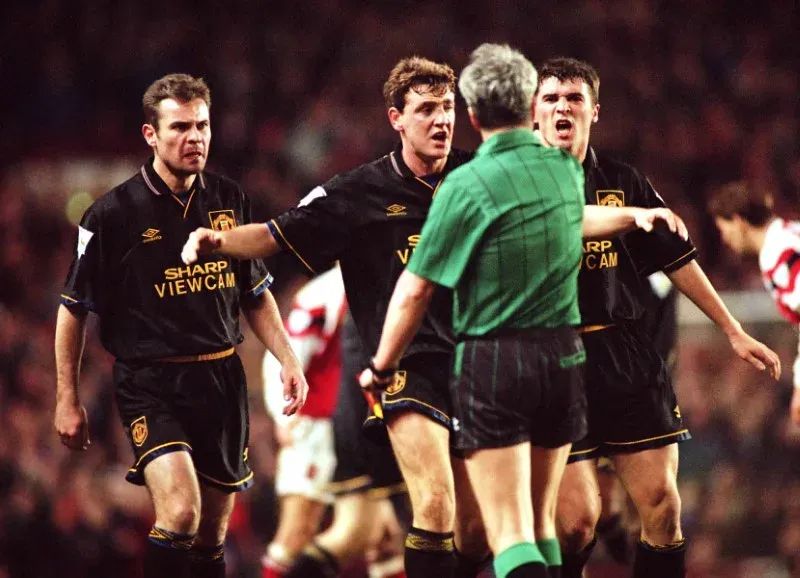
The acknowledgements at the front of Roy Keane’s first autobiography, published in 2002, are brief and to the point. Eleven lines of businesslike appreciation of those who edited, transcribed and ghost-wrote, who “helped me tell my story”. The person he thanks last is his agent. “And of course for so much, so generously given, to Michael Kennedy. Pity he’s an Arsenal fan.”
Keane’s hatred of Arsenal defined his Manchester United career. He was indelibly associated with them, and in particular Patrick Vieira. As well as all the iconic moments, in tunnels and even on football fields, various important career landmarks involved Arsenal. Keane made his United debut against Arsenal and played against them more than any other club in his 12-and-a-half years at United. If you count penalty shoot-outs, which is exactly what we’re going to do to fit our preferred narrative, he scored his first and last goals for United against them. Most symbolically, he captained United for the first time at Highbury in 1997. And Arsenal are surely the only club that could prompt a rare foray into the world of banter in the acknowledgements of an autobiography.
His disregard for Arsenal preceded his move to United. Keane grew up in Cork as a Spurs fan, idolising Glenn Hoddle, and during his time at Nottingham Forest he was almost arrested at Highbury. In April 1993, Keane continued his demented one-man mission to keep Forest in the Premier League by scoring a 94th-minute equaliser against Arsenal. He was already in the bad books of the home fans after putting Nigel Winterburn on a stretcher earlier in the game, and his overzealous celebration of the goal led to a visit from Uncle Plod on the team coach after the game. Keane was taken back to the dressing-room for questioning.
“Keane allegedly lifted his shirt, kissed it and made abusive comments to the crowd,” said Inspector Daniel Keogh. ''The matter has been passed on to the match referee who has indicated he will report the incident to the FA.”
In the end no action was taken, but it was the continuation of a headline-grabbing season for Keane on and off the field: he was sent home from a club trip to Jersey, and fined a week’s wages, after brawling with a man whose wife had poured a gin and tonic over his head. (Keane reciprocated, serenely pouring his drink over hers, at which point the husband intervened and fists became active.)
In the week of the Arsenal game he was sued for defamation by an ex-girlfriend from Cork, who claimed £15,000 damages after he allegedly called told her to “Shut up, you whore” and “suck me, bitch” outside a nightclub a couple of years earlier. The case was eventually heard in 1995, when a judge decided the comments – Keane admitted the first but denied the second – were not defamatory.
On the field he was largely magnificent, and his refusal to accept the bleedin’ obvious - that Forest were going down – drew admiration from all quarters: he was included in the PFA Team of the Year, the first player since Trevor Brooking 15 years earlier to do so when his team were relegated, and was voted Player of the Year by Forest fans.
The police may have let him off, but Keane was England’s most wanted in a different sense. As well as interest from all of England’s biggest clubs, he was linked with Real Madrid and Sevilla, who were keen to put him alongside Diego Maradona. Keane had impressed Maradona during a World Cup qualifier against Spain in Seville the previous November.
Keane eventually decided to join United, despite shaking hands on a deal with Blackburn manager Kenny Dalglish. At first it seemed Blackburn’s financial clout would swing the deal. For most of his three years at Forest, Keane was on £700 a week. That was increased to £5,000 in March 1993 after Clough found out he was overdrawn. Blackburn offered twice that, but Ferguson charmed Keane over a game of snooker at his home.
Arsenal were also interested, but Keane turned his nose up at their approach. “Forest have informed me that Arsenal want to see me,” he said. “But I’m 90 per cent sure of what club I want to join.” (Arsenal did sign a Republic of Ireland midfielder that summer. Eddie McGoldrick wasn’t quite what their fans had in mind.)
Keane announced he wanted to go Old Trafford and then waited while the two clubs agreed a deal. “Keane’s done himself no harm by stating that he wants to come to United,” said Ferguson. “It shows he's got ambition. I'm delighted with that type of attitude.”
This post is for subscribers only
Subscribe now and have access to all our stories, enjoy exclusive content and stay up to date with constant updates.
Already a member? Sign in