“We have a marvellous product and it deserves to have a marvellous image"

The F.A. Blueprint for the Future of Football, June 1991 

There was more to Sky’s early Premier League coverage than a live match every Sunday and Monday. They introduced a series of additional programmes with varying degrees of success. The Boot Room, presented by Andy Gray, was the first time English football came out as a tactical entity; the Footballers’ Football Show was essentially a pub chat among ex-pros.

Then there was Hold the Back Page, a wildly entertaining forerunner of Sunday Supplement. The format was the same but the atmosphere was not – instead of Sunday morning, it was shown on Friday or Saturday night. And instead of croissants and orange juice, there were glasses of water and a strident discourse that suggested something more robust had been on offer in the green room.

The programme was introduced at the start of the 1994-95 season. Had Sky known what would happen over the next nine months, they would have called it Hold the Front Page. For one year only, with no particular rhyme or reason, English football became the biggest scandal in town. The 1994-95 season became known as the Season of Sleaze – or, as FourFourTwo magazine put it, The Year Football Went MAD!
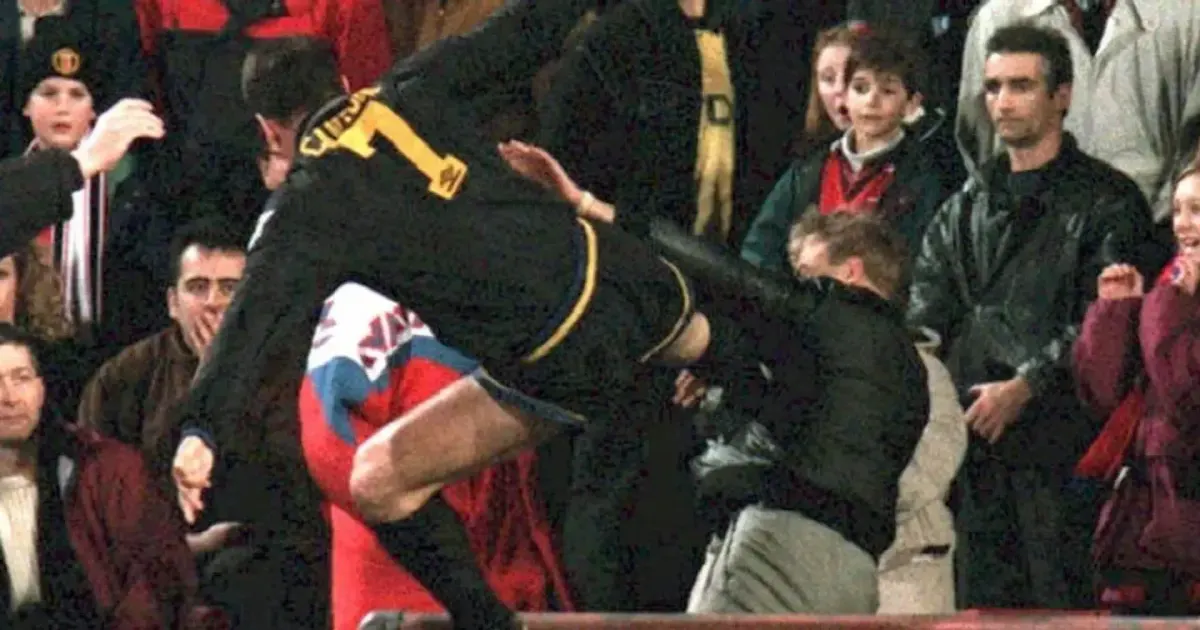

When the Football Association made their landgrab by introducing the Premier League, a cast list of wrong’uns were not in the brochure. The 1994-95 season shattered the goofy optimism that had existed in English football since Italia 90. In no particular order, it included:

  • A pre-planned National Front riot at Lansdowne Road, which led to Ireland’s friendly with England being abandoned.
  • An on-pitch brawl, for old times’ sake, between Millwall and Chelsea fans after an FA Cup tie at Stamford Bridge.
  • Front-page allegations of match-fixing against Bruce Grobbelaar, John Fashanu and Hans Segers.
  • Chelsea midfielder Dennis Wise receiving a three-month jail sentence – later overturned on appeal – for assaulting a 65-year-old taxi driver.
  • Vinnie Jones almost committing suicide because of the fallout after he bit a journalist on the nose.
  • Spurs being banned from the FA Cup and having 12 points deducted in the league (both were eventually overturned).
  • Chris Armstrong becoming the first Premier League player to fail a drug test after testing positive for cannabis.
  • The death of a Crystal Palace fan, Paul Nixon, after he was attacked by Manchester United fans at Villa Park before the FA Cup semi-final.
  • Sackings galore, including the historically significant month of November 1994, the symbolic start of a culture in which P45s are the easiest response to a dip in form.

We’re not quite done. As befits the two least popular teams in England, Arsenal and United topped the unofficial sleaze table. Eric Cantona provided the defining moment of the season when he tried to kung-fu kick racism out of football at Selhurst Park. At Arsenal, Paul Merson went into rehab after announcing he was addicted to cocaine, and George Graham was sacked for allegedly taking a bung.

The end of Graham’s nine-year stay at Highbury was a drawn-out affair. He was eventually sacked in February 1995 – but it was on the cards from the previous September, when he first told Arsenal he had received metaphorical brown envelopes worth £425,000 from the Norwegian agent Rune Hauge. In November, a week before a home match against Manchester United, Graham handed in a resignation letter. The terms had been agreed with the board, with Graham due to stay on until the end of the season before leaving the club ostensibly on good terms, citing the usual crap about wanting a new challenge.

At that stage Graham’s resignation was not common knowledge. A few days later, Paul Merson went public with his addiction problems. He went into rehab and missed the game; so did the emerging Ray Parlour, whose face was injured after he was glassed during a fight at Butlins in Bognor Regis.

In the absence of Merson, Parlour and the injured Stefan Schwarz, Arsenal put out a midfield of Jimmy Carter, Steve Morrow, John Jensen and Eddie McGoldrick. It was as if Graham was trolling the Arsenal fans who had been pleading for a creative midfielder for years.

Arsenal were going nowhere, stuck in 11th after their now familiar false start. And though United were top of the Premier League, a point ahead of Blackburn and Newcastle, the one they really wanted was slipping away. Three days earlier they suffered an embarrassing 3-1 defeat away to IFK Gothenburg which all but ended their chances of reaching the knockout stage of the new Champions League.

It was the fourth season in a row that United would go out of Europe before Christmas. Arsenal fans serenaded them with an old favourite: “One Team in Europe”. It was factually incorrect (United were not officially out, and Chelsea were still in the Cup Winners Cup) but still guaranteed to hit United fans where it hurt. There were also songs about Hristo Stoichkov and Romario, who had tormented United when they lost 4-0 at the Camp Nou earlier in the month, and a few Barcelona shirts to be seen among the Arsenal fans.

The Gothenburg defeat hit Ferguson so badly that he couldn’t even bring himself to watch the players train on the Friday before they went to Arsenal. The team arrived at Highbury in a vile mood and played out a bone-jarring 0-0 draw. “It was pretty gruesome stuff,” said the usually neutral Trevor Brooking on Match of the Day that night. “It’s just as well the highlights were after the watershed.”

United named a different team for the 20th consecutive game, a sign of their upheaval but also the newfangled rotation that Alex Ferguson had embraced. In that, as in so much else, he was years ahead of his time. One of the men who came in, the teenage winger Keith Gillespie, was booked after 23 seconds for a studs-up tackle on Lee Dixon. The referee Kelvin Morton waved the card, as he would most of the others, with a self-important flourish.

Both teams spent the afternoon baring their teeth, metaphorically, and their studs, literally. Paul Ince and Ian Wright, who were great friends, two-footed each other at the same time when a 50/50 ball presented itself. Both got straight to their feet without complaint. Wright won the ball, and with it the bragging rights. The United captain Ince, who had been sent off for excessive use of the mouth in that Gothenburg defeat, seemed determined to make it two red cards in a row. In the second half, having just been booked for a late tackle on Paul Dickov, he should have been sent off for a much more dangerous tackle that put Jensen out of the game. Even though the ball bounced at thigh height, Ince still managed to go over the top of it with a wild flying challenge. As Jensen lifted his leg to shoot, Ince nailed him painfully on the shin.

Carter also went off at half-time with injury, caused when Gary Neville attempted a clearance, was beaten to the ball by a split-second and instead almost volleyed Carter’s right ankle downfield.

His replacement, Dickov, might also have walked for a dismally high tackle on Brian McClair. “The arrival of Dickov, 5ft 5ins of concentrated venom,” wrote David Lacey in the Guardian, “did not improve the game’s humour.”

It was obvious a red card was in the post; the only question was who would receive it. It was Mark Hughes, in the 78th minute, for a second yellow card. He was fouled by Wright – play restarted with a United free-kick – and then, off balance, lunged at Morrow. Hughes, working on the sheep/lamb hanging theory, told the referee Kelvin Morton to “fuck off” before stomping down the tunnel.

Most felt Hughes had been hard done by – including the usually neutral Brooking on Match of the Day, which showed a montage of Hughes’ Achilles being assaulted throughout the match, with no defender being punished. In this particular game, there were probably 10 players more deserving of a red card.

Ferguson felt the referee had been influenced by the home crowd. “When we come here,” he said after the game, “it’s always a big game for the Arsenal fans.” In A Year in the Life, a brilliant and almost unbelievably candid diary of the most exhausting season of his career, he elaborated on his thoughts. “An absolute joke,” he said of Hughes’ sending off. “He was knocked and fell into the boy. He hardly touched him and he goes down bloody pole-axed. Bloody sickening. That’s twice, two years in a row, with Arsenal that we’ve had someone sent off, and you have your doubts about the way the Arsenal player has gone down.

“The home crowd were screaming at every tackle. I don’t know where it is coming from, but last year in the 2-2 game, the support was fanatical which you don’t always get at Arsenal. I can only assume it was because they were playing United.”

Ferguson felt that Ince’s tackle on Jensen was the only bad one of the match. “I was quite pleased with the character of the side, because Arsenal are very aggressive and we stood up to it.”

It was a miserable day, emblematic of a remorselessly dark season. “For some reason, Arsenal and United bring out the howling, hacking beast in each other, like two sets of werewolves who always meet at full moon,” wrote Richard Kurt in As the Reds Go Marching On. “Imagine a grumpy Sunday park game with two hungover sides who’ve been nagged by the wife all week and who are likely to gob the next bastard who goes through them and you have it in a nutshell.”

In the Times, under the headline ALEHOUSE FOOTBALL, David Miller bemoaned the “wanton abuse of the game … by those who should know better”. He then saw the time-honoured ‘think of the children’ plea and raised it. “I fear that football now too often sets bad example for one’s dog, never mind the next generation of teenagers.”

Miller was referring to all the aggression, but the dogs wouldn’t have thought much of the attempts at football either. In the Guardian, Lacey called it a “witless farrago” and then added, “If anyone of Merson’s colleagues are thinking of offering a newspaper the revelation that they have a footballing habit they should be warned that rejection is likely on the grounds of implausibility.”

The closest either same came to a goal was when Gary Pallister cleared off the line from Wright, whose unwelcome portfolio of hard-luck stories against United had another entry. “In any game against Arsenal,” said Ferguson, “the main thing is stop Wright scoring and we did that well.” Yet Wright’s flair and effervescence were among the few things that made the game worthwhile.


It was the last time Ferguson came up against an Arsenal side managed by Graham. He was sacked in February for accepting illegal payments from Hauge. “It no doubt sounds like a bung, and looks like a bung, but it was a gift,” he said in The Glory and the Grief. “And I did not ask for it.”

The FA later found Graham guilty of misconduct and banned him from football for a year. Graham says Hauge gave him two gifts, one in 1991 and 1992, as a thank you for helping him access the British market. One such introduction Graham made was to Alex Ferguson. Hauge had offered Graham first refusal on Andrei Kanchelskis and Peter Schmeichel. He wasn’t interested – “Kanchelskis would not have fitted in with Limpar, and … I had already had an even better goalkeeper in David Seaman” – but suggested Hauge try United, who eventually signed both players. The Kanchelskis deal was later investigated by the same FA inquiry that found Graham guilty. They concluded that “there is no evidence to suggest than any irregular payments were made by Mr Hauge to anyone at Manchester United”.

“I couldn’t understand Arsenal [sacking Graham],” said Ferguson. “They knew about it last October or thereabouts … so it’s a bit surprising that they go and carry out the sacking today … it’s sad for a great manager to leave in that way.”

With Graham gone, Arsenal’s already mediocre league campaign drifted away to the point where they were briefly in a relegation battle. They were easily beaten in the return fixture, 3-0 at Old Trafford, and left Old Trafford in 14th place, only four points off the relegation places. “George Graham is a marvellous manger,” wrote Ferguson, “and you look at the situation and wonder if Arsenal have been wise.”

A one-sided match, in which Kanchelskis scored his last goal for United, is best remembered for things that happened off the field: in the tunnel, over the tannoy and even in London.

Arsenal's selection in central midfield of Morrow and Martin Keown didn't exactly scream jogo bonito. “They set up a system of man-marking,” said Ferguson. “And they were really going right through with their tackles. Almost from the start I could see what was going on, and I said: ‘Oh, the referee’s going to have his work cut out here.’”

United were not entirely innocent, and a contest between Roy Keane and the Dutch winger Glenn Helder was always likely to increase the referee’s workload. It looks strange with hindsight, ludicrous even, but Keane had a two-month  spell during the 1994-95 season when he was United’s first-choice at right-back. There were a few reasons – Paul Parker’s injuries, David May’s struggles and a spell when the emerging Gary Neville was in the doghouse with Alex Ferguson after overdoing it on K cider. “It’s gone to your head, Neville,” said Ferguson, and he didn’t mean the cider.

Keane would soon become irreplaceable in central midfield, and the Arsenal match was the last time he ever started at right back for United. He spent the match regularly introducing Helder to the lush Manchester grass.

Arsenal were competitive until they went 1-0 down, at which point the towel went in. Before Hughes’ opening goal, Wright almost scored with a booming lob from the centre circle – familiar now, outrageously then – that beat Schmeichel and drifted just wide. Schmeichel had not conceded a league goal at Old Trafford for 11 months, and loathed the emasculation being lobbed from any distance, never mind 50 yards. In the burgeoning, unspoken battle of two of the Premier League’s biggest egos, a goal like that would have forever given Wright the final word.

It might also have put him in a better mood at half-time. As the end of the first half approached, Wright was booked for clattering Steve Bruce, who returned the compliment and also received a yellow card. An increasingly irritated Bruce told Wright he was going to knock him out at half-time. “Right, let’s have it then,” said Wright. “Tunnel. I am the fucking tunnel man!”

When the half-time whistle was blown, Wright sprinted straight down the tunnel. As Bruce walked towards him, Wright apologised and said they should both calm down. Bruce dropped his guard – at which point Wright chinned him and ran off.

“I couldn’t stop laughing,” said Lee Dixon on Quickly Kevin. “I think Brucey said something like, ‘Is that your best shot?’ And Wrighty said, ‘Have a look at your eye when you get yourself in the dressing room.’ He chased him around the pitch for the second half trying to get hold of him.”

The papers got hold of the story in the next few days, and Bruce’s black eye meant there was no point anyone denying it. United did not acknowledge it publicly until Ferguson’s end-of-season diary. “Wright had a wee skirmish with Steve Bruce in the tunnel,” he wrote. “He is a lucky lad, because we’re prepared to let it drop, and Bruce is prepared not to take it any further. It wasn’t serious. It could’ve developed into something, but the players were good and got Brucey away from him. I said to the big guy: ‘What the hell’s going on now?’ He apologised.

"Wright is quite a lucky player because he treads a thin line at times. He’s an excitable lad - even off the pitch. People of that nature never change. Good striker, though. Maybe if he’d gone to a club where they do a lot of linking and he was forced to go and link and develop his technique he could have been a better player, but Arsenal have used him in the way they think is best. He’s been a great buy for them.”


The match was also a landmark in the gentrification of Old Trafford. In the match programme, supporters were threatened with having their season tickets or membership books revoked if they stood up during play. In a full-page advert, “standing during play” was apparently an equivalent offence to “racial abuse”, “foul, abusive or threatening language or gestures” and “threatening behaviour”. Then, during the first half, a tannoy announcement reinforced the message.

“This had to be an attempt at wacky, Pythonesque humour, right?” wrote Richard Kurt. “Like all around me in the East stands, I could hardly believe what I’d heard. It felt like a desecration of this hallowed football temple, not to mention being the most shit-mouthed, enraging insult the club has hurled at us – and there have been plenty to choose from down the years. [It was a] A “declaration of war by the Club on the true Red.”

Chris Robinson, the editor of the fanzine Red Issue, went even further. “At half time on 22 March I felt as if the football world I’d grown up in, a world of passion, commitment, camaraderie that was envied around the globe had had the last rites served … at that moment I had drummed into me what I’d suspected bur daren’t believe for a while. The old-time supporter, the supporter who could remember the barren years and didn’t measure his support in the collecting of Megastore carrier bags just wasn’t welcome at Old Trafford anymore.”

Robinson formed the Independent Manchester United Supporters Association (IMUSA) two days later, largely in response to that tannoy announcement. It was literally done on the hoof. Robinson and Kurt were among a group of 15 United supporters who went down to London in a minicab and car straight after the game to support Eric Cantona, who was in court the next day charged with common assault after kung-fu kicking a Crystal Palace supporter in January. Before that they were to appear on the Big Breakfast to publicise Eric the King, an EP of terrace chants about their idol.


Cantona missed the Arsenal match, having been banned for nine months.  Ince was also due at Croydon Magistrates the next day, so he travelled down to London after the game and met up with Cantona. They went to a secret Prince gig at the Emporium in London and enjoyed the company of, among others, Paul Gascoigne and Mel Gibson before eventually returning to their hotel just before 5am.

Cantona was initially given an two-week prison sentence, which turned a routine day outside court into a JFK moment, though the sentence was later reduced to 120 hours community service. Ferguson found out about Cantona’s sentence at Buckingham Palace, where he was receiving an OBE. An eventful day took a gruesome twist when he was told when he was told of the death of Davie Cooper, the brilliant winger who was part of Ferguson’s World Cup squad in 1986, at the age of 39.

There was no happy ending for United or Arsenal. United lost the league to Blackburn by a point, having missed a series of late chances to win at West Ham on the final day, and were then beaten 1-0 by Everton in the FA Cup final. Arsenal finished in 12th, their lowest position since 1976, and lost the Cup Winners’ Cup final to Real Zaragoza in astonishing circumstances. With the score 1-1 after 119 minutes, and players on both sides starting to think about where they would put their penalties, the former Spurs player Nayim beat Seaman with an outrageous 50-yard lob.

The rest of the country was high on schadenfreude. In the same FourFourTwo issue that documented the season of sleaze, readers were asked to vote for a number of categories, one of which was ‘The Team You Love to Loathe’.

United were top with 271 votes, Arsenal second with 133. No other team got more than 40.

The link has been copied!