
I'll See You Out There
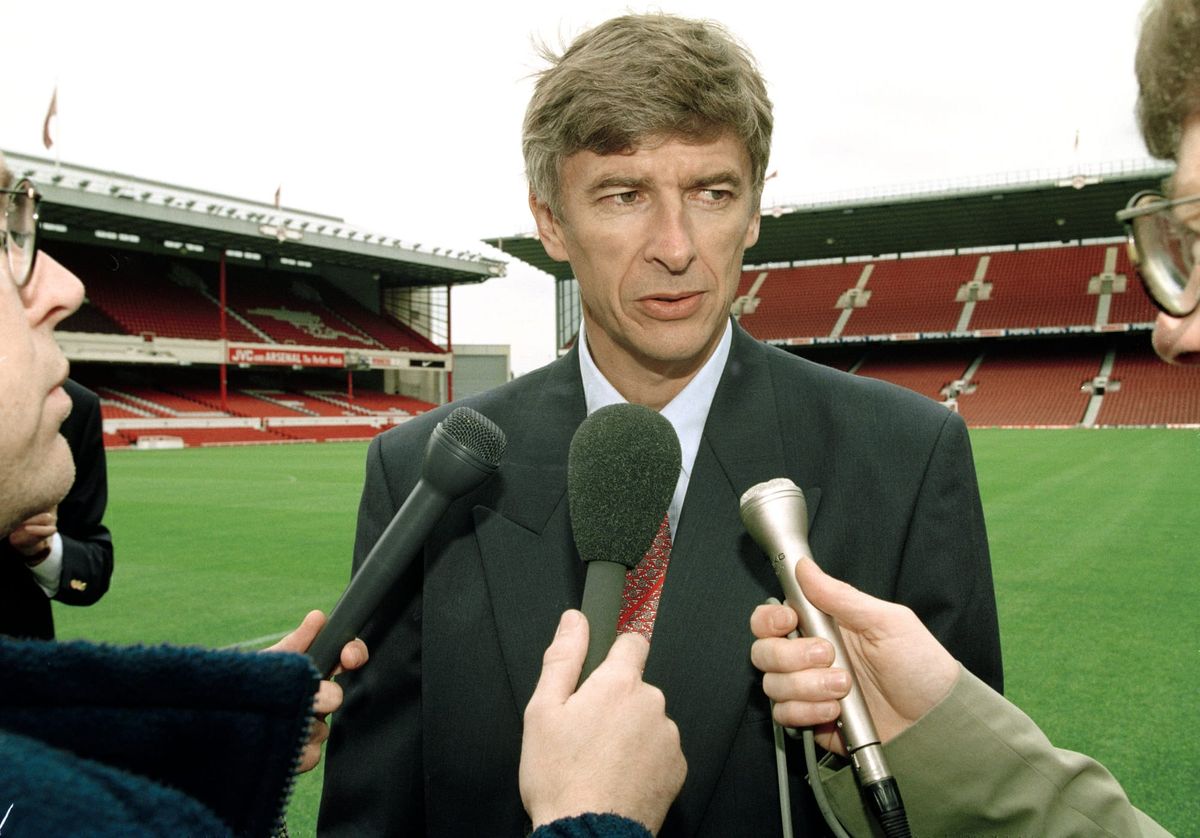
If the past is a foreign country, then so is the future. Arsene Wenger was one of the few people in English football who appreciated this when he agreed to become Arsenal manager in 1996. No foreign coach had been successful in England but Wenger arrived with a couple of cheat codes: his expertise in physiology and French football. He was about to do things very differently.
Wenger came into a culture that was insular and confused, with simultaneous superiority and inferiority complexes. There were scarcely any foreign players in England in the 1970s and 1980s, in contrast to the other major European leagues, and the ban on English clubs playing in Europe from 1985 to 1990 compounded the sense of isolation rather than globalisation. On the first weekend of the Premier League in 1992-93, there were only 13 foreign players. (Pub quiz, hotshot.)
Things had started to change by the start of the 1996-97 season. The Premier League had attracted players as good as Gianluca Vialli, Ruud Gullit, Dennis Bergkamp and Faustino Asprilla, even if some were in the twilight of their careers. But foreign managers at any stage of their career were not welcome in England. Only two had managed in the top flight, both unequivocal failures: the superb Josef Venglos, who led Czechoslovakia to the quarter-finals of Italia 90, lasted only a season at Aston Villa and Ossie Ardiles’ Spurs were a laughing stock for their freestyle approach to defending. Gullit was appointed Chelsea’s player-manager in the summer of 1996, and soon after it became an open secret that Wenger would replace Bruce Rioch at Arsenal.
Wenger had considerable pedigree: he had won a league title with Monaco, with a side including Glenn Hoddle, and reached the semi-finals of the Champions League in 1993-94. But in England, only avid readers of World Soccer would have known much about him. In 1996 few people knew how to use the internet; those who did had little idea what to use it for. “ARSENE WHO?” was the headline in the Daily Star.
“I remember when Rioch was sacked, one of the papers had three or four names,' said Nick Hornby. “It was Terry Venables, Johan Cruyff and then, at the end, Arsene Wenger. I remember thinking as a fan, I bet it's fucking Arsene Wenger. Trust Arsenal to appoint the boring one that you've never heard of.”
The fact he had spent his last two seasons managing Grampus Eight in Japan was used as further evidence that he was a nobody, even though his impact there had been dramatic: in two years he took them from second bottom to second top and they won the prestigious Emperor’s Cup.
Hoddle, the new England coach, gave him a glowing recommendation when he joined Arsenal. The word of Hod was not gospel. The fact Mark Hateley, Jurgen Klinsmann and George Weah, the reigning Ballon d’Or holder, were equally effusive made no difference.
Wenger’s appointment was a story of knowledge (his) and ignorance (ours). “One of the biggest bets was how long I would last,” said Wenger. “Everybody was betting I would be gone by January 1st.”
When his appointment was officially announced, a reporter from the Evening Standard phoned Arsenal to ask whether his name was pronounced Wenger or Venger. The person on the other end of the phone had no idea.
David Dein had known for years. Dein, the vice-chairman, became friends with Wenger when they met at Highbury during a match between Arsenal and Spurs in 1989, starting a personal friendship that later became a professional love affair. Those who believe in serendipity might thank Wenger’s parents for calling him Arsene – the phrase “Arsene for Arsenal” stayed in David Dein’s brain – or those at Uefa for drawing Monaco against Galatasaray in the quarter-finals of the 1988-89 European Cup. When Wenger went to scout Galatasaray in a 1-0 defeat at Konyaspor on New Year’s Eve, he decided to fly home via somewhere that didn’t have a winter break so that he could watch more football. Good old England. During Arsenal’s win over Spurs, Wenger developed an instant liking for English football.
Dein first tried to make Arsene for Arsenal a reality in 1995, but could not convince the board. They were more susceptible to his ideas when they decided to get rid of Rioch after a year. If Wenger’s appointment was football’s worst-kept secret, then only David Dein really had an idea of the best-kept secret: that Arsenal had found a genius.
While Rioch had lost the dressing-room, or at least some of it, Wenger’s biggest challenge was to find the dressing-room. He wasn’t just a foreigner; he was an alien. “I up-and-downed him,” said Ian Wright. “He didn’t look like a football man.” He was nicknamed Inspector Clouseau by Ray Parlour because he was French and clumsy, with a habit of knocking things over.
And did we mention that he was French? Tony Adams later recalled thinking: “'What does this Frenchman know about football? He's not going to be as good as George [Graham]. Does he even speak English properly?”
Wenger also wore circular, rimless glasses, which to many gave him the appearance of a schoolteacher, and at first some of the players were like giggling kids at the back of the class. They had no idea. Wenger was not just a coach; he was a life coach. Lee Dixon says Wenger made him a more rounded player and person. “Without him,” said Adams a few years later, “I would be dead now.”
Adams’ personal circumstances were extreme – he had just given up drinking – but all of the team benefitted from Wenger’s alternative views on diet and refuelling. Everything the team knew was wrong. They were, as Wenger phrased it, putting diesel in a petrol car. They drank enormous amounts, even by the standards of English football in the mid-1990s, and their diet was hopeless. The French midfielder Remi Garde remembers his surprise at seeing a jar in the dressing-room. “It was like an orgy of sweets,” he said. “They were there instead of the cereal bars and energy drinks you’d be used to seeing in France.”
Wenger gently point out that eight pints and steak and chips might not be entirely conducive to consistent athletic excellence. His time in Japan had made him even more aware of the importance of food – “You notice when you live there that there are no fat people” – and he tipped Arsenal’s existing diet on its head, into the bin. Wenger introduced broccoli, steamed fish, broccoli, white meat, pasta, rice, broccoli and broccoli. He even changed the way the players ate, encouraging them to “chew to win”; eating slowly meant they would consume less before the brain indicated that the body was full.
He also gave the players vitamins and Creatine, though, unlike the diet, they were optional. “You knew you were in the frame if you got the supplement package from the physio Gary Lewin,” says Adrian Clarke, who was in the first-team squad at the start of Wenger’s reign. Later that season Clarke went on loan to Rotherham. When he came back he noticed a series of differences and one in particular: the sheer power of the team. Other players in the England team soon started asking the players what they were on and followed suit. Except at Manchester United, where there was increasing suspicion.
The Arsenal players rebelled at first, and would chant “We want our Mars bars back” on the coach back from away games, but they soon accepted that broccoli allowed you to work, rest and play far more effectively. So did sobriety. Wenger came in at the perfect time: Adams, whose voice was so powerful in the dressing-room, had given up alcohol and England as a whole was starting to come down after the relentless excess of Britpop and Cool Britannia. The last of Oasis’ concerts at Knebworth, which some deem the end of that period, took place on the same day that the Charity Shield started the 1996-97 season.
Wenger made sure sweating out the past was fun. Training was based on football and enjoyment rather than running and punishment. Everything was done on the stopwatch, with no exceptions even if the players wanted to carry on and play next goal wins. Wenger found hopeless facilities when he joined, but a timely fire – the joke goes that it was Arsene – accelerated a move to the purpose-built London Colney.
Wenger also introduced a number of stretches, a brave move in the ultra-masculine world of English football that associated such things with Lizzie Webb in lycra on TV-AM. “He told us about all the stretches we’d be doing,” says Dixon. “And we stretched. For fun. Every day. Three times a day. Before training. During training. Post training. And then the food changed. “
But quickly – very quickly – the players felt the benefits: they were fitter, happier and infinitely more productive. That earned Wenger the trust of the dressing-room. They also loved his manner, and his approach to the game. “He was just incredibly calm, respectful; the best word is nice,” said Martin Keown. “That was what was so great about him. You wanted to play for him because you liked him. He made the club a happy place to be.” In much of English football, the player/manager relationship had a whiff of Stockholm Syndrome; Wenger changed all that.
Wenger had a finite advantage because he was enlightened about so many things that would become the norm: diet, fitness, vitamins – and foreign players. Arsenal signed two French players on his recommendation: Garde, an experienced utility player from Strasbourg, and Patrick Vieira, a France Under-21 midfielder who was on the fringes at Milan because of the foreigner rule and about to sign for Ajax when Wenger gave him a compelling alternative. Arsenal had no French players in the first 110 years of their existence; Vieira was the first of 25 in the next two decades.
The writers of the Times’ season preview were not impressed with either development. “Barely 14 months have elapsed since the last shock, horror, probe at Highbury and then, bingo, Bruce Rioch is on his bike, five days before the Premiership opens,” it said. “It is somehow sad to see that a club steeped in such rich tradition can be reduced to little more than unfathomable soap opera … And who are Garde and Vieira?”
Easy to sneer with hindsight, but it was a common viewpoint. The paradox of English football in the mid-1990s is that it was desperate to impress those on the continent yet was suspicious of most foreigners who came to play in England. They were, as Seaman put it, “dodgy foreigners until they proved themselves in our league”. In the early days of Wenger, foreign signings were a joke among the players. They didn’t see the world, they quoted Wayne’s World: “Here comes another well-known signing. Not.”
Before Arsenal’s 4-1 win over Sheffield Wednesday in a televised match on a balmy Monday night in September, Wenger introduced himself to fans on the big screen. They went home talking about another Frenchman. Patrick Vieira made his first appearance for Arsenal as a first-half substitute after an injury to Parlour, and played with such assurance, class and – shock, horror – creativity that it was more like his testimonial than his debut. “He was,” said Wenger later, “like a genie from the lamp.” Arsenal came from 1-0 down to win 4-1, with Wright scoring a hat-trick. Vieira’s stylish, authoritative performances at the start of his Arsenal career gave Wenger instant credibility inside Highbury and around the country.
Wenger officially took over on October 1, and his first game in charge was a 2-0 win at Blackburn, with Wright scoring two masterful goals. The second was made by Vieira, who whipped an insouciant pass with the outside of the right foot. It does not look much these days, but in 1996 it was almost a watercooler moment when a Premier League footballer used the outside of his foot. A week later, Arsenal went top of the table for the first time in four years after drawing with Coventry.
First he changed the physiology of the players, then he changed the DNA of the team. Both Wright and Paul Merson, who said he had “by far my best season”, spoke about the sheer enjoyment of the football in those early days. Clarke neatly sums up the other way in which Wenger won the players over: “Who doesn’t want to play fast, attacking football?”
Even Arsenal’s famous back four of Dixon, Adams, Steve Bould (or Keown) and Nigel Winterburn were encouraged to get forward. Or at least they weren’t discouraged to cross the halfway line in open play. Had they done that under Graham, they would probably have been fined two weeks’ wages.
It is almost impossible to overstate Wenger’s physical and mental impact on the back four. He put two or three extra years on their careers – and made those years far more enjoyable by trusting them to do more than just defend. As they became monastic off the field, so they were able to enjoy the good life on the field.
“I was 32, so I thought, ‘Let’s have a go’,” says Dixon. “What was the other option? I never wanted to leave the club. It was a good time to be around, because we knew what to defensively so he didn’t have to do anything with us. He’d just leave us alone. His training was different, all done on a stopwatch, lots of plyometrics. It had got boring under George at the end, so it was all fresh and interesting.
“I had three mates, four with the goalie, who I knew inside out. Our bit of the game - we’d sussed that out, we knew what to do. But there was definitely a more relaxed atmosphere about letting us go forward. The gaffer said to me a few times, ‘Just go and play.’ I used to get the ball and think, ‘Bloody hell, I’ve never seen so many red shirts to pass to, who shall I pick?’ It made the game really easy. Later on, Arsene said to me: ‘I didn’t realise how good you all were – not just as a unit but as players.’”
Two moments, both in open play, summed up the new freedom: Adams’ left-foot volley to help Arsenal win a memorable derby at home to Spurs, and Adams’ own Beckenbauer moment against Leicester, when he waved an outside-of-the-foot pass to Bergkamp and then kept running to head Bergkamp’s cross into the net. Though nobody realised it at the time, they were prequels to one of the greatest moments in Arsenal’s history.
Goals change games. Occasionally, they change lives. When David Beckham scored from the halfway line in a 3-0 victory over Wimbledon on the opening day of the season, he set his life on a completely different path. “Oh, trust him.” muttered Ferguson on the bench as Beckham took the shot before joyously exclaiming the Goal of the Season a few seconds later. Three weeks later Beckham won his first England cap, and by the end of the season he was both PFA Young Player of the Year and boyfriend of the Spice Girl Victoria Adams. He quickly went from being in vogue to being in Vogue.
The goal empowered him to take a shortcut to the cusp of greatness. Between 1996 and 1999, Beckham was unquestionably the best of the Class of 92, and in 1996-97 he produced an astonishing portfolio of goals: free-kicks, long-range howitzers, precise curlers and imaginative chips. In 1987-88, the BBC’s Goal of the Season competition famously involved nothing but Liverpool goals. Nine years later, they could have done the same with Beckham.
United signed five foreign players in the summer of 1996: Raimond van der Gouw, Ronny Johnsen, Karel Poborsky, Jordi Cruyff and an unknown, cherubic Norwegian striker called Ole Gunnar Solskjaer, who scored eight minutes into his debut against Blackburn with the kind of rasping, decisive finish that would become the norm. They missed out on Alan Shearer, who, depending on whose story you believe, chose Newcastle ahead of United or was prohibited from joining United by the Blackburn owner Jack Walker. “He probably broke down crying,” said Ferguson. They also missed out on the hulking Barcelona defender Miguel Angel Nadal, uncle of the tennis player Rafael. “They're playing silly buggers,” said Ferguson, “but these things sometimes happen when you are dealing with foreign clubs.”
United were distracted by the allure of the Champions League for much of the 1996-97 season. That made for some difficult moments domestically, not least during a miserable spell that coincided with Ferguson’s 10th anniversary at Old Trafford. They conceded 11 league goals in seven days, with a 5-0 defeat at Newcastle – after which the Newcastle chairman Sir John Hall proudly announced that “you have seen the champions today” – followed by a 6-3 shellacking at Southampton. They had 10 men for much of the latter match, with Roy Keane, looking ever more menacing than usual with a beard that oozed feral chic, sent off early on, but that didn’t reduce the ignominy. It was a particularly miserable experience for the goalkeeper Peter Schmeichel: not only did he concede 11, but two of them – from Newcastle’s Philippe Albert and Southampton’s Matthew Le Tissier – looped goadingly over his head. For tall goalkeepers, especially those with stratospheric egos, there was no more exasperating or emasculating way to concede. Jokes about why Schmeichel did not have salt or vinegar in his house – he didn’t like chips – did the rounds.
It got worse for United. They struggled in Europe, losing at home for the first time in their history, to Fenerbahce, and a third straight league defeat followed – 2-1 at home to Chelsea, which left them in sixth. They were eight points behind the leaders Newcastle and six behind Arsenal, who were unbeaten in the league under Wenger. The first half of the title race was extremely open; even Wimbledon went joint top with Arsenal after winning seven games in a row. “We don't want too many sides getting too far ahead while we are still occupied by Europe," said Ferguson, whose side were due to play Arsenal next.
United’s fragility dominated the pre-match discourse. “WENGER TO END FERGIE REIGN” was the headline in one newspaper, continuing a proud British tradition of completely ignoring what someone actually says in favour of a more interesting headline.
"We can do more psychological damage to United with a win at Old Trafford,” was what Wenger actually said. "When a team loses two, three then four games it can start to affect the mind… It is everybody's dream of gaining the respect United have, but my team have already achieved something special because no one expected us to be near the top.”
The return from medium-term injury of Ryan Giggs, who was never more talismanic than between 1996 and 1998, gave United both comfort and electricity. Even though he was a winger his significance was such that he felt like part of the team’s spine. The match was the last between the sides to kick off at 3pm on a Saturday, and the last Premier League meeting not to be televised, two things that are unlikely to change in the next few hundred years.
Arsenal started with the 3-4-2-1 formation they used for most of Wenger’s first season, with Merson and Bergkamp floating behind Wright. Bergkamp knew he had been flagged offside in the third minute but decide to chip Schmeichel all the same, to remind him of the past and warn him of the future.
With Roy Keane suspended, Beckham moved alongside Nicky Butt in midfield and had a compelling contest with Vieira. His lung-busting performance exemplified the bristling determination of United. He hit the post early on with a beautiful 20-yard shot with the outside of the foot and was the most influential player on the pitch. Vieira, who was Arsenal’s best player, might have been booked for plunging his studs into Beckham’s ankle and was booked straight after for pulling him back – even if Beckham seemed to dive. In a parallel universe they spent the next decade as direct opponents for club and country.
For the first hour it was the kind of game in which you felt something was always about to happen, even if it rarely did. Arsenal, unsurprisingly given the form of both sides, played the more confident football, but United bristled with the unique defiance that is evident when a superpower have their back to the wall on their home ground. As the match went on United, like recovering amnesiacs, began to remember who they were.
They should still have gone behind just before half-time. Wright, through on goal, overran the ball and ended up sliding in late on Schmeichel, prompting the pair to exchange unpleasantries on the field and then in the tunnel. David Platt, the Arsenal midfielder, was particularly animated as the players left the field at half-time, pointing angrily at somebody, presumably Schmeichel, in the distance. The United substitute Brian McClair, in his role as PFA rep, decided to wait in the tunnel in case there was any trouble. As he did so, a familiar face walked past. “It makes a change from me and you, doesn’t it?” said Winterburn.
Winterburn managed to make unwelcome headlines nonetheless by scoring an unfortunate and mildly farcical own-goal to give United the lead. “As a fellow professional I felt for him,” said McClair, “just as, in 1988, he commiserated with me on my unfortunate penalty miss against Arsenal in the FA Cup.”
Wenger said the game was about “details” and that was summed up in the 62nd minute. Johnsen made a vital interception to stop Wright running through on goal from Bergkamp’s pass; 20 seconds later United were ahead. It was an unusually scruffy goal for Arsenal to concede: Dixon overhit a backpass, Seaman prevented the corner but gave it to Butt, and in the ensuing scramble Winterburn unwittingly shovelled the ball into his own net as he fell. After a month of misery, United’s unfettered celebrations were a study in catharsis.
With the game opening up United had a number of opportunities on the counter-attack, with Cantona and Poborsky missing one-on-ones. The most significant chances fell to Arsenal, however, with Schmeichel making two vital point-blank saves from Wright in the dying minutes. He didn’t so much make himself big as make himself huge. After the second of those, in injury-time, Schmeichel dived gleefully onto the ball like a winger scoring a try – and prompted the kind of triumphant roar you rarely hear when a save is made.
“Man of the Match this man,” said the BBC commentator Barry Davies of Schmeichel after that save. “Who said he lost his nerve when 11 went past him?”
It was yet another frustrating afternoon against United for Wright, who had gone into the game in blistering form after scoring 13 in his previous 11 games. Against any other team, he would surely have taken at least one of the chances. “I was a striker and all I wanted to do was score past Peter,” he said. “But he wanted to make sure I never scored against him, and I only did it once in a Charity Shield game. Playing against him, he must have made three or four of the best saves I've ever seen. He was just so driven to make sure I didn't get the ball past him.”
Schmeichel smiled as he applauded the United fans. His opposite number Seaman winced: his ribs had been cracked in a challenge with Solskjaer, which ruled him out for two months.
The defeat was Arsenal’s first under Wenger, the start of a recurring theme of one side ending the other’s unbeaten run. Ferguson gave him a pat on the back at the end of the game and then a metaphorical one in the press. Ferguson had tipped Newcastle and Liverpool as United’s rivals at the start of the season but revised his view after the game. "Arsenal have a strong claim and are looking very powerful. Wenger has done the right thing since arriving. He has stuck with experience. Tony Adams is also fit again. Last year he was out for half a season and they missed his influence.”
United had missed Schmeichel’s, even though he was in the team. His performance against Arsenal revived United and ended the most difficult period of his Old Trafford career. Or so he thought.