
Marco van Basten died to save football. Not literally, and certainly not voluntarily, but his premature retirement was the catalyst for law changes that promoted skill and ended the legitimised thuggery of the 1970s and 1980s. The balance between skill and strength has probably gone too far the other way, but at least the world’s best players no longer have their ankles kicked to smithereens. There’s a reason the last five Ballon d’Or winners have all been in their thirties.

Van Basten played his last professional game at the age of 28, for Milan against Marseille in the Champions League final of 1993. “Marco was the greatest striker I ever coached,” said Fabio Capello, the former Milan coach who broke down in tears when the San Siro paid its respects to Van Basten. “His early retirement was a mortal misfortune for him, for football, and for Milan.” If Capello is crying, you know it’s serious.

Even after retiring at 28, Van Basten left a spectacular legacy. He won the Ballon d’Or three times; he was part of Arrigo Sacchi’s revolutionary Milan team that won back-to-back European Cups; he was also the star when Capello’s Milan went unbeaten throughout the 1991-92 Serie A season. But there is one moment that is shorthand for his greatness: the astonishing volley against the USSR in the final of Euro 88.

Many Dutch sportsmen are obsessed with achieving perfection. They aim for something that cannot be explained and might not even exist; they’re almost striving for Godot. Van Basten came as close as anyone ever will.

The notion of the Total Footballer is romantic nonsense – try putting Johan Cruyff at left-back against Jurgen Grabowski – but Van Basten was a Total Striker. If boffins created the ultimate 20th-century centre-forward, he is what they would have come up with. The things Van Basten couldn’t do weren’t worth doing. He was tall, fast, technically immaculate and with an intimidating elegance that suggested to defenders he was not of this earth. It’s rare to see players of his height with that much grace, and he was nicknamed “the Swan of Utrecht”.

Everything he did was smooth and knowing. His pulse rate stayed the same when he entered the penalty area, and his awareness was such that he seemed to have a bird’s eye view of the pitch. He could finish with either foot or his head and score every type of goal, from tap-ins to delicious long-range chips.

In 1983-84, at the age of 19, he hit 28 goals in 26 games for Ajax and was the Eredivisie’s top scorer. He repeated the feat in each of the next three seasons, at which point a move abroad became inevitable. Serie A was becoming as strong as any domestic league has ever been, and so he went to Milan to join his fellow Dutchmen Ruud Gullit. Frank Rijkaard would also move to the San Siro after Euro 88 to complete one of modern football’s most iconic sides.

An ankle operation, an early sign of trouble – he’d been playing with torn ligaments for nearly a year – meant that Van Basten missed most of the 1987-88 season, but he returned to help Milan grab the title from Diego Maradona’s Napoli. That it was their only title under Sacchi, even though they won two European Cups in the next two years, shows how formidably strong Serie A was in those days.

In the first game of Euro 88, a rusty Van Basten was left on the bench, with his former Ajax teammate John Bosman preferred by Rinus Michels for the match against the USSR. When he came on, he was used out of position on the left wing. The Netherlands were playing in their first major tournament for eight years, having failed to qualify for the World Cup in 1982 and 1986 and the European Championship in 1984; despite playing well, they lost 1-0 to a spectacular sucker punch from Vasyl Rats.

Van Basten came in at centre forward for the second match, a mustn’t-lose game against England. Although England hit the post twice at 0-0, the Netherlands won 3-1 with Van Basten scoring all three. It was the first hat-trick against England since 1959 and, though the first one should almost certainly have done as an own goal by Gary Stevens (watch it at 0.25 speed on YouTube), it didn’t diminish Van Basten’s devastating impact.

In those days the European Championship was an eight-team tournament, with the top two from each group going through to the last four. The Netherlands had to beat Ireland in the last group game to get through to the semi-finals, and were going out until Ronald Koeman’s mishit shot was headed in by the substitute Wim Kieft with eight minutes to go.

That meant a semi-final against West Germany, the hosts and hated neighbours who had beaten Cruyff’s great Total Football side in the 1974 World Cup final. Michels, the coach back then, returned for Euro 88. After both teams exchanged penalties, Van Basten slid a superb 89th-minute winner to put the Netherlands into the final.

Or, rather, into their second final. For most of the team – though not Van Basten – beating West Germany alone was enough. It was some kind of revenge for World War Two and the 1974 World Cup. They went straight off to a nightclub to celebrate, and the next few days had an end-of-term feel. Gullit later said the final was “a holiday” and that, after beating West Germany, they could have gone home happy.

Happy was the operative word. This was that rarest of things: a harmonious Dutch team. When the players talk now about Euro 88, it is as much about the friendships as the football. Developing such spirit and shared purpose was Michels’ greatest achievement. On the day before the final, the team presented him with a gold watch to thank him for being the best coach they had played under.

The night before that match, the whole squad went to see Whitney Houston in concert. They got in trouble with stewards for disobeying orders to stay seated; even Van Basten, the kind of man who usually wouldn’t wanna dance with somebody in private, never mind public, was on his feet.

On the morning of the match Michels told his team how well they had done, but also pointed out that the Netherlands had never won a major tournament and that, after losing the World Cup finals of 1974 and 1978, maybe it would be quite nice to win the bloody thing this time. That speech, says Gullit, snapped the players into game-mode.


It was Gullit who gave them the lead against a good USSR side with a thumping close-range header, dreadlocks flapping as he rammed his head into the ball with brain-shaking force. In different circumstances it would have been an iconic goal. Instead it became a footnote.

It was widely noted that Van Basten’s injuries in 1987-88 helped him at Euro 88, as he was fresher than almost everyone else in the tournament. That was true in a wider sense, but his goal in the 54th minute was actually the result of fatigue. Van Basten felt tired as he ran to meet Arnold Muhren’s overhit cross from the left. That, and the fact there was nothing else on, is why he decided to try a volley from an impossible angle. “I thought okay, for heaven’s sake just smash it at the goal,” he said in Basta. “I haven’t got the energy to do anything else with it.”

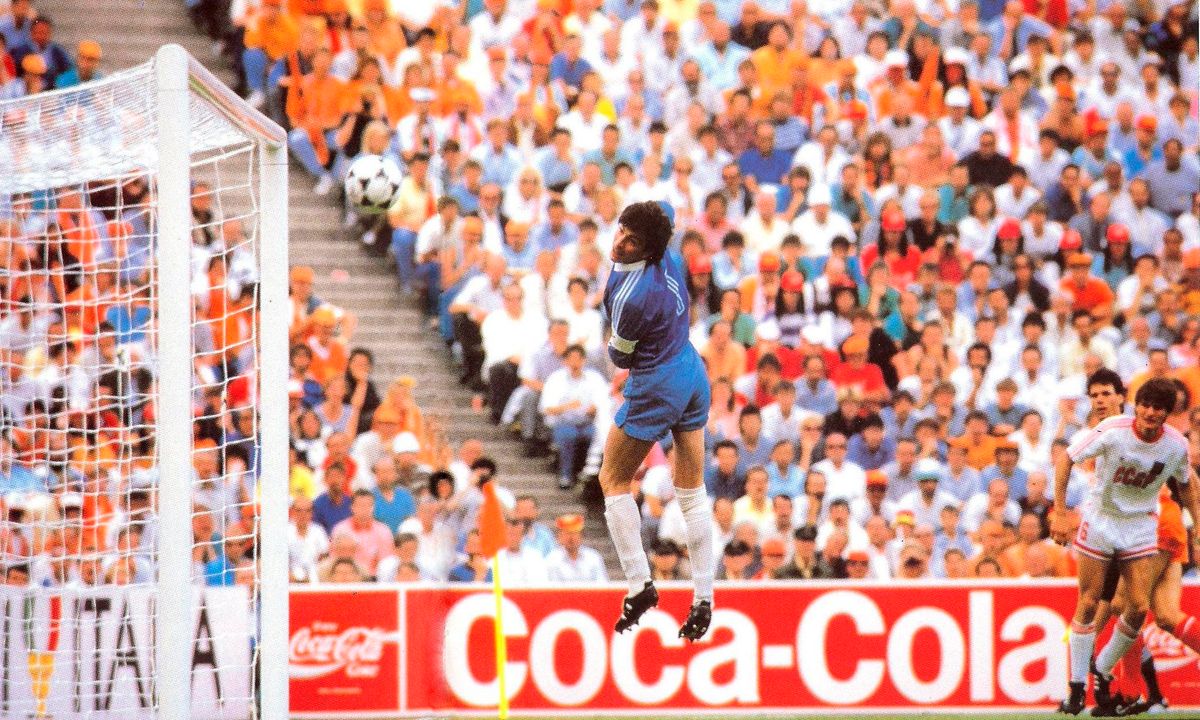
Even he could not have imagined what would happen next: he smashed a volley back over Rinat Dassaev, probably the world’s best goalkeeper, and into the far corner. Van Basten’s follow-through took both feet high in the air, his limbs bent like an action figure. It was a technically perfect volley and one of those rare goals that makes those watching do a double-take.

Even the goalscorer struggled to process it. “I was in a state of total disbelief,” said Van Basten. “Wow, what just happened? You can see it in my face as I run back to the halfway line. I didn’t believe it myself.”

It was a staggering goal in more ways than one. When he landed after leaping in an attempt to save it, Dassaev stumbled around his six-yard line like a man who’d been on the eggnog all morning. Michels put his hand over his face and, for a few seconds, staggered around dazed, unable to comprehend what he had just seen. He looked on the verge of tears.

Michels was the godfather of Total Football, who managed the first great Dutch side in 1974, yet even he did not realise football could ever be this good. Never mind the gold watch; for a football purist like Michels, this was the ultimate gift. His face was a picture of gratitude and joy. (In a neat and presumably unwitting homage, Dennis Bergkamp also thrust his hands over his face when he scored his legendary World Cup goal against Argentina in 1998.)

An interesting knock-on effect of Van Basten’s goal is that it changed how history recorded that Netherlands side – as high-class, emphatic winners rather than what they actually were: an excellent, likeable side, but one that, like most tournament winners, had plenty of luck at important moments.

Not that there was anything lucky about Van Basten’s goal. His brilliance throughout the tournament was such that his coup de grace brooked not a solitary argument. Even in an age of ostentatious iconoclasm, nobody of sound mind disputes that, at the very least, it is the greatest European Championship goal ever scored. There are no hot takes on offer here.

In 1986 and 1987, Van Basten received 10 votes in the Ballon d’Or. In 1988 he received 129 – and won it, with his club and country team-mates Gullit and Rijkaard in second and third place. He did so again in 1989, after helping Milan to the first of two consecutive European Cups. In Milan’s unbeaten season of 1991-92, he scored 25 goals, the most in a Serie A season for 26 years. Later that year, he completed a hat-trick of Ballons d’Or. Only Lionel Messi and Cristiano Ronaldo has won more.

But he wasn’t exempt from football’s vicissitudes. Van Basten and the Netherlands were a desperate disappointment at Italia 90, when they were eliminated in the last 16 without winning a game; the peerless historian Cris Freddi later called them the biggest disappointment at any World Cup. Van Basten also missed the decisive penalty in the Euro 92 semi-final, when they were eliminated in a shootout by Denmark. He also missed Milan’s European Cup exit in 1990-91 through suspension after breaking the cheekbone of Club Brugge defender Pascal Plovie with an elbow.

In December 1992, during a game against Ancona, his ankle problems recurred and he required another operation. He returned towards the end of the season and played in the Champions League final against Marseille, when Milan lost 1-0 to a goal from Basile Boli. In the second half, Boli was booked for butchering Van Basten from behind. Van Basten complained furiously to the referee Kurt Rothlisberger, who smiled at him like a parent patronising a child.

That game was the Van Basten’s last. All those tackles from behind, defenders going through him with impunity, had ruined the cartilage and ligaments in his ankle. An unsuccessful operation left him unable to walk for a while. In the night, if he needed the toilet, he had to crawl to the bathroom, trying to suppress any yelps of pain so that he wouldn’t wake his family up. “Football was my life,” he said, “and I was dying as a football player.” He tried for two and a half years to make a comeback before formally retiring in 1995.

Van Basten’s final game, that miserable Champions League final, was on the same ground in Munich where he scored against the USSR. The relationship between the two doesn’t end with that coincidence. Van Basten has a theory that the injury that ultimately ended his career also facilitated his defining moment.

“I no longer have a full range of movement in my right foot,” he said. “Since [the operation in 1987], I had reduced mobility there and could no longer take on such a ball at full power. With a good ankle I would very probably never have scored. And ultimately maybe it was a kind of ‘divine intervention’, because of what happened to my ankle. I really do believe that. A certain balance between unfairness and payback. In a way that goal was a gift from God.”

Van Basten wasn’t the only recipient. It’s rare to see such a spectacular goal in a final, because usually the tension and the weariness of a long campaign take their toll. Get the thing won and to hell with how it looks. Zinedine Zidane’s monstrous volley to win the 2002 Champions League for Real Madrid is the most obvious comparison, though that was scored from a central position rather than an impossible angle. If a simple equation for a goal’s greatness is quality multiplied by context, Van Basten’s might be the best of all time. A goal to die for.

The link has been copied!