2. Wild nutter
Arsenal’s young team were top of the league and full of the joys when they arrived at Old Trafford in 1987. One man soon changed that
Remi Moses had plenty of time to play in an FA Cup final. He was 22 when he missed out in 1983, and United were going places, Wembley being one of them, under Ron Atkinson. But tomorrow never came. When United next reached the FA Cup final two years later, Moses was out with a niggling injury that wouldn’t go away. He eventually had to retire at the age of 28.
The injury occurred in February 1985, two days before a trip to Highbury, when Moses twisted his ankle while crossing the ball in training. It looked innocuous, but he had jarred a calf muscle and it never properly healed. He had started all 38 games for United that season and was expected to make his England debut against Northern Ireland four days after the Arsenal game.
For the trip to Highbury, United replaced him in midfield with the versatile Paul McGrath. But when Kevin Moran was injured in the 15th minute, it necessitated a reshuffle. There was only one sub in those days, so McGrath moved into defence and the striker Norman Whiteside came on in midfield. He was a revelation and scored the winner with a beautiful 20-yard curler.
Necessity was the mother of expedition rather than invention. The United manager Ron Atkinson had always foreseen Whiteside moving back into midfield as his career developed, not unlike Ray Kennedy when he went to Liverpool, but now the process was accelerated – especially as Moses missed the rest of the season and was only able to start four games in the next 18 months.
Whiteside took over his duties in midfield, one of which was to drive Arsenal to distraction. He regularly tormented them by fair means and foul. At the start of the following season, he attended to Steve Williams – Peter Nicholas’s replacement as Arsenal’s midfield hard man, who had terrorised United’s Danish winger Jesper Olsen in that game at Highbury a few months earlier – with a first-minute stamp. “Williams,” wrote David Lacey in the Guardian, “was not so much fouled by Whiteside as mugged after the ball had gone.”
Williams struggled on for a while before limping off with a fractured toe. He was out for two months. United won that game 2-1, the third of 10 consecutive wins at the start of the league season. Both United’s goals came while Arsenal were temporarily down to 10 men, with Williams and then David O’Leary needing treatment. O’Leary was left with a swollen jaw after walking into Mark Hughes’s elbow, while Tony Woodcock also suffered concussion. “Two or three of United’s players need to be told to discipline their approach,” wrote Lacey, “so as not to confuse hard, competitive play with assaults occasioning actual bodily harm.”
Arsenal gave plenty back, with United’s impish wingers, Olsen and Gordon Strachan, the subject of gruesome fouls from Viv Anderson and Stewart Robson respectively. “It would be interesting,” wrote Brian Glanville in the Sunday Times, “to learn what this referee considered a bookable offence.” But there more was to United’s dominance than abnormal levels of testosterone. In his Times match report, Stuart Jones said United’s football “touched the most glorious heights”.
United famously collapsed that season, finishing fourth despite their awesome start: they took 41 points from the first 15 games and 35 from the last 27. One of their more damaging defeats came at home to a very young Arsenal side just before Christmas. Whiteside, who captained United at the age of 20, had a stinker for the ages. He missed a penalty and accidentally set up the only goal of the game when his pass out of defence hit Colin Gibson and rebounded to put Niall Quinn through on goal. His shot was saved but Charlie Nicholas scored from close range. Whiteside then missed a sitter in injury-time. Arsenal fans were given an early Christmas present: industrial quantities of schadenfreude.
Quinn had spent the morning of the match wandering around Manchester city centre looking to buy a Christmas present for himself, a new pair of trainers. He did not expect to be playing and returned just in time for the pre-match meal. “Most of that day is a blur but I remember Gus Caesar seeming to kick Jesper Olsen from one end of Old Trafford to the other …” he wrote in his autobiography. “It was an ugly game, looking back, the football of cavemen.”
Quinn was one of three teenagers, along with Caesar and Martin Keown, in the Arsenal team. “They have given us a little bit of life,” said the manager Don Howe. “Keown, especially, looks a hell of a good player.” Although those three players wouldn’t have a huge impact at Highbury – at least not, in Keown’s case, in his first spell of the club – it was the start of an exciting new era built around home-grown players. Arsenal had become a dowdy club, little more than mid-table strugglers, but that was about to change.
The focus on youth became even greater when George Graham replaced Howe as manager at the end of the 1985-86 season. Howe resigned in March when he learned they had approached Terry Venables. What was not common knowledge is that they had also approached the Aberdeen manager Alex Ferguson.
Ferguson loved the grandeur of Arsenal: the marble halls, the bust of Herbert Chapman – and, maybe one day, Alex Ferguson. “I think that Arsenal are the most glamorous team,” he said in 1983, “and I include Manchester United when I say that.” Despite that Ferguson turned Arsenal down after they sacked Terry Neill in 1983, as he was not quite ready to leave Aberdeen. He almost took over at Spurs in the summer of 1984 but then changed his mind. By 1986, there was no cure in Scotland for his itchy feet.
The problem was his other managerial commitment. He was about to manage Scotland in the World Cup, having taken over as interim manager after the death of Jock Stein during a qualifier in Wales in September 1985, and did not want to commit to anything until after that. Arsenal, who wanted to appoint their new manager before the World Cup, were not willing to wait.
That, at least, is Ferguson’s truth. When it comes to Arsenal and Manchester United, there are two sides to many stories. David Dein, then the Arsenal vice-chairman, says that, though he met Ferguson a couple of times in Aberdeen, they chose to give the job to Graham. “We didn’t offer the managerial post to Alex Ferguson”, a quote that is either categorical or semantic – Ferguson may never have been offered the job because he and Arsenal couldn’t agree on when he might take it. What is not in doubt, giving the timings cited, is that Arsenal spoke to Ferguson long before Graham. And that, for a long time, it looked like Arsenal had got the better manager.
Graham’s first game as Arsenal manager was a 1-0 victory over Atkinson’s fading United on the opening day of the 1986-87 season. Nicholas got the winner again, but Arsenal fans went home talking about an exhilarating performance from the 19-year-old right-winger David Rocastle, whose skill and adventure put some poetry into an otherwise prosaic game. One of the few incidents of note occurred when a wine bottle was thrown onto the field from the United end, a rare and strangely endearing example of yuppie hooliganism.
By the time the teams next met, Atkinson had been sacked and replaced by Ferguson. United were in 19th place when Ferguson arrived in November, with only goal difference keeping them above Chelsea and out of the relegation zone. (Manchester City were also in the bottom three, which shows how much football has changed, along with Newcastle, which doesn’t.) He stabilised United, making them more resilient and harder to beat, but they were still struggling in 13th – their highest position of the season to that point – when Arsenal came to Old Trafford in January.
Arsenal were league leaders and in spectacular form. After a slow start to the season, they were on a club-record unbeaten run of 22 games in all competitions. United were 23 points behind them, only five clear of the relegation places. In the build-up to the game, Ferguson, a master of giving a little with one hand and taking a lot more with the other, praised Arsenal to the hilt and then concluded that Everton would win the league.
He then decided to reunite their midfielders with an old friend. Whiteside had played in his old role up front more often than not since Ferguson came to Old Trafford. But with Bryan Robson and Moses injured, Ferguson wanted him in the middle of he field to add a bit of grunt.
In the second minute, he set an emphatic tone with a challenge on David O’Leary that was somewhere between slapstick and custodial. It started with a piece of brilliance from Whiteside, who weaved past three Arsenal players on the edge of the area. As O’Leary came across to clear the ball, Whiteside hacked at fresh air with such force that he ended up in a horizontal position a few feet off the ground, his legs scissored around O’Leary’s waist. Then, as gravity took over and Whiteside fell backwards towards the floor, the bottom half of his body flipped up like a seesaw and he booted O’Leary in the jaw.
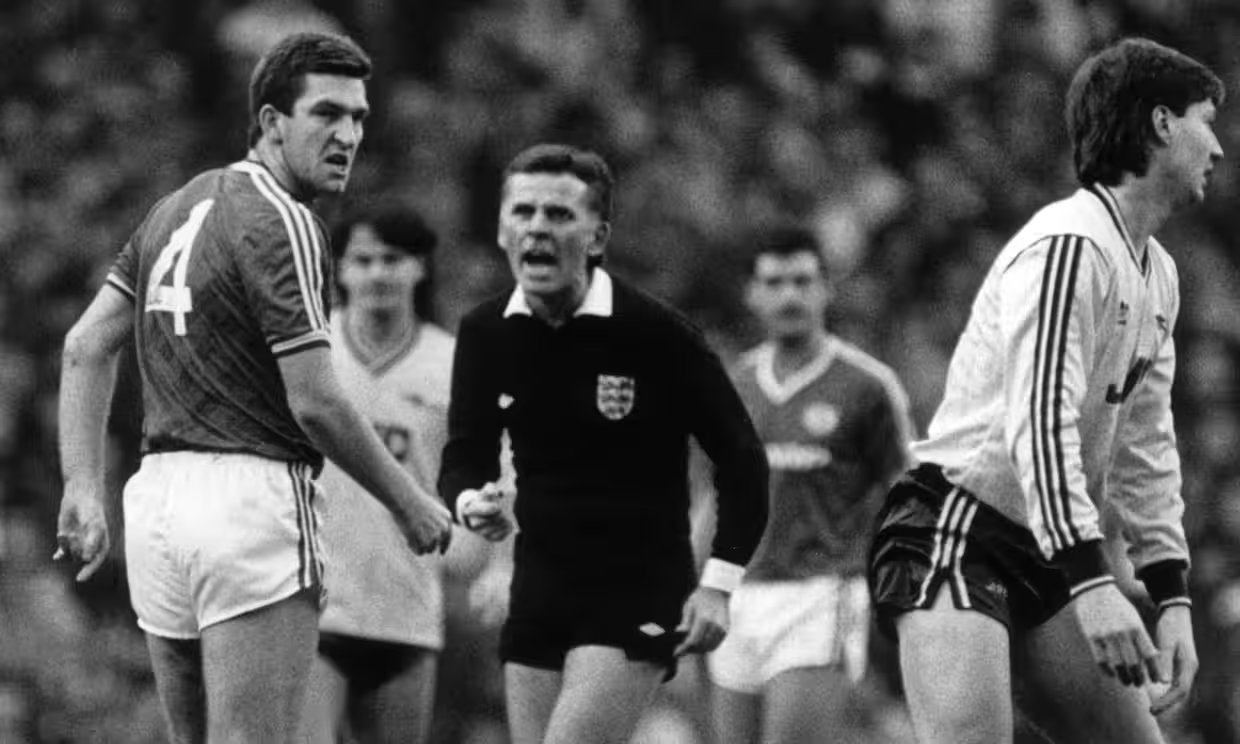
A contortionist couldn’t have done it better, and it could easily have passed for an accidental reflex as Whiteside fell backwards. Arsenal didn’t believe in accidents, not where Whiteside was concerned, and there was a melee as they appealed to the referee George Tyson to do something. He didn’t, so Whiteside continued to assiduously drag Arsenal down to his level.
The match was a satire of English football in the 1980s – all thud and blunder, full of challenges that would be an instant red card in modern football. The past has a cartoon quality, however, and it’s hard not to laugh when you see Kevin Moran chasing his own heavy touch with such earnest zeal that he ends up ploughing through Paul Davis, who flips up like he’s been run over by a high-speed car.
Whiteside was eventually booked for repeat offending - after 20 minutes. Yep. The last two came in quick succession. First Whiteside planted his studs in Rocastle’s chest as they competed for a bouncing ball. The referee had just started to signal that Arsenal should play the advantage when Whiteside gave him cause to scramble for his whistle – and his notebook – by sending Davis flying.
Whiteside reined it in after that. He was a world-class niggler, with the instinctive ability to weight his assaults – and, where necessary, to make them look clumsy – in a way that meant a referee could rarely be entirely sure of malicious intent. They know, but they don’t know. It explains why, absurd though it sounds, Whiteside was never sent off during his Manchester United career.
He got a few players sent off, though. In the second half, Arsenal’s temper went to another level when Strachan gave United the lead. There was at least one and probably three fouls in the build-up, the most blatant of which was Frank Stapleton’s WWF manoeuvre on Tony Adams. “The goal had all the merit,” said Clive White in the Telegraph, “of somebody winning with marked cards.”
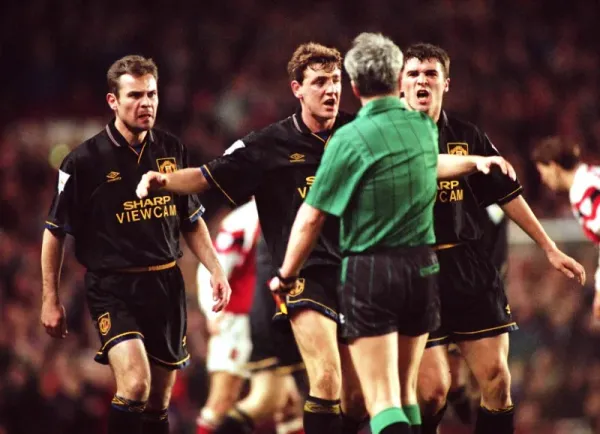
A minute later Whiteside had a hack at Rocastle, who hurdled the tackle but lost the ball in doing so. The ball ran to Whiteside, who had his right leg dragged from under him by a retaliatory challenge from Rocastle. As he fell and rolled over, Whiteside studded Rocastle in the chest – another assault that had just enough doubt regarding intent to stop the referee to give him a second yellow card. Rocastle’s response, an unambiguous hoof up the arse as Whiteside lay on the floor, left no such doubt.
As the referee called Rocastle towards him, the players on both sides piled in for a bit of aggro. Arsenal’s experienced right-back Viv Anderson charged over to Whiteside and got right in his face.
“What you doing getting a young kid sent off you dirty fucking cunt?”
Whiteside noticed that Anderson’s fist was clenched, ready to administer some vigilante justice. The two players were briefly separated, at which point Whiteside enticed Anderson by smiling cockily and making the ‘come on then’ gesture with both hands. When Anderson walked over for the second round of the debate, his head leaning forward to within kissing distance, Whiteside started whispering sour nothings. “Punch me, go on. Please hit me. I dare you. Be a man, you know you want to. Come on, knock my lights out.”
Anderson was desperate to clean Whiteside’s clock, but “something inside stopped me”. Eventually he was dragged away by Charlie Nicholas. Anderson was booked and Rocastle, inevitably, was sent off. (It was probably a second yellow card, as he had already been booked, though in those days it wasn’t always clear - until the early 1990s the referee did not show a yellow and then a red.) It was a rare example of somebody retaliating to the retaliation to the retaliation.
It was also as a textbook example of a grizzled veteran suckering an innocent young player into losing his temper. A grizzled veteran who was one of the youngest players on the pitch. “Norman was 21?!” says Terry Gibson, who played up front for United in the game. “You’re joking! Jesus. That’s shocking, that someone of 21 went around intimidating David O’Leary and people like that. You look back and think, ‘My God, how did he do that?’”
There was understandable sympathy for Rocastle, who vowed bitterly that he would never be stitched up again, but that doesn’t mean he was unfortunate to be sent off. He might have gone earlier – in the minutes before the Whiteside incident, he was booked for flattening Gibson, who hadn’t even hit the floor when he started scrambling to his feet in a why-I-oughta pose, and might have had a second yellow card for a late tackle on Whiteside.
Arsenal’s collective discipline disappeared when he was sent off. When play eventually resumed, two and a half minutes after the original foul by Whiteside, their prime motive was not to get an equaliser in the game but to settle scores. They couldn’t decide whether they wanted to maim Whiteside or provoke him into getting sent off. They managed neither, though Davis was booked for a tackle that started in a different time zone. “Even Whiteside must have been surprised,” wrote David Lacey in the Guardian, “at the ease with which his opponents had swallowed the bait.”
Arsenal ended the match with five yellow cards and one red card, a minor scandal in those days. Their grievance was less with the cards they received and more with the ones United, particularly Whiteside, did not. By the values of 1987 he should have been sent off at least once, maybe three times. By the values of 2021 he should be doing a stretch.
It could have been a lot worse. Anderson, who was booked for his earlier contretemps, was lucky not to be sent off when he threw the ball away in disgust. Williams threw a flagpole at a steward after being shoved into it by Gibson. O’Leary later dragged Gibson over by the neck; Gibson, already booked, responded by throwing half a punch. Soon after he settled the match with a tap-in and responded by raising one finger to the Stretford End. It was Gibson’s first (and, as it turned out, only) goal for United, a cathartic moment for a player who was starting for the first time at Old Trafford – a year after joining the club.
Arsenal fumed and foamed with impotent rage, and were almost tipped over the edge when, for reasons that weren’t immediately clear, the referee Tyson made them retake the kick-off. When the match finished moments later, Anderson and O’Leary gave the referee another mouthful. Kenny Sansom, the Arsenal captain, said he had never seen O’Leary as angry as he was after that game. O’Leary and Quinn went for Ferguson’s assistant Archie Knox in the tunnel, blaming him for encouraging the referee to send Rocastle off, and were stopped by a policeman from an impromptu two v one. When the melee finally dispersed, the officer of the law had a stern word with Knox. “You should have belted one of them,” he said. “I’d have let you off with it.”
The tunnels at Old Trafford and Highbury could tell a thousand stories. Graham, the Arsenal manager, had admired Ferguson from afar and was looking forward to meeting him for the first time and picking his brain over a post-match drink. Instead they ended up having a slanging match in the tunnel, and came within a hair trigger of a full fistfight.
There was the inevitable moral panic after the game. The Sunday Telegraph compared it to the Wild West, while the Observer called it a “disgraceful brawl … vicious, dangerous and unforgivable”. The Mirror christened it ‘the Battle of Old Trafford’, a phrase which, given the methodology of Whiteside in particular, had an appropiate acronym.
Ferguson had a different view. “Absolutely magnificent fare,” he cooed after the game. “Everything that could happen at a football match happened, save for a penalty. It was an almanack of football and great for the spectators.” This led to some concern among the English press pack as to the precise nature of civilisation in Scotland.
After that, Ferguson turned his attention to Arsenal’s discipline. “Some Arsenal players tried to referee the game, and brought anarchy into it… Only one - Tony Adams - came out of the game with any credit… I would never be associated with a team that stepped outside the laws of the game… You could see the game running away from them. They knew they were going to lose and it wasn’t easy to handle. When you’ve gone 20-odd games without defeat you forget what it’s like to lose. In these sitjations it’s understandable. Players are human beings after all.”
Arsenal’s argument was that, if they were refereeing the game, it was because somebody had to. “The damage was done in the first 20 minutes,” said Graham. “I thought the referee lost control of it. There was one man who absolutely ruled the game for 20 minutes … Football was the loser. There were hundreds of fouls out there. The better team won, but next time I hope there’s a football match.”
Arsenal were so disgusted with Whiteside that most couldn’t even bring themselves to say his name. As well as Graham talking about “one man who absolutely ruled the game”, Rocastle later referred to “a certain player… I thought I should have been sent off, but the other player should have been sent off with me.”
Even a decade later, in his book the Glory and the Grief, Graham was still unable to say the W-word. “One of the United players,” he said, “rushed around making dangerously wild tackles.” It was as if the Arsenal dressing-room made a pact never to say his name again. Either that or they feared a curse if they named the Northern Irish player.
After the game, O’Leary was too angry to stick to any pact. “Whiteside,” he announced, “was running amok like a wild nutter.” What other kind is there?
“It all started with a fierce tackle on me in the first few minutes, but the referee ignored it. Whiteside came at me like some sort of fruitcake. He was out to poleaxe me. He kept up this sort of thing for the while game but got away with it. He was running around like a lunatic. He seems to get away with it at Old Trafford.”
‘Wild nutter’ is a memorable description, usually repeated whenever this game is discussed, but it’s not strictly true. Although Whiteside roamed the green with malevolent intent, there was nothing wild about his behaviour. He was like a swan in reverse – flapping frantically on the surface, but serene and in control beneath it. “Cute, he was,” said Ferguson a few years later. “So cool and calculating about it. He was booked but never had one foul against him from that moment. Arsenal were frantic … they were almost slavering for revenge. Norman set the time bomb ticking and then just stood back laughing at everybody else.”
Not for the last time, Arsenal left Old Trafford nursing an almighty grievance at the manner in which their unbeaten run ended. It affected them so much that they didn’t win another league game for almost three months, by which time the title was long gone. (Everton did win it, as Ferguson predicted.) But in that time they famously won the Littlewoods Cup, coming from behind to beat Liverpool 2-1 at Wembley. It was their first trophy in eight years and only their second since the Double-winning season of 1970-71.
A month after the Battle of Old Trafford, Anderson went away on England duty, where he shared a room with the United captain Bryan Robson. During one of the longeurs that punctuate international breaks, Anderson took the opportunity to get something important off his chest. “That Whiteside,” he said. “He’s a fucking wanker.”
Robson burst out laughing, only to realise instantly that Anderson was in no mood. On the next England trip, Robson told Anderson that Ferguson was keen to sign him for United that summer. Ferguson had been so impressed with Anderson’s reaction to the Rocastle red card that he decided he wanted him.
“Big Norm set that one up, and Viv feel for it hook, line and sinker,” said Ferguson. “But the way Viv behaved that day, showing he was a footballer prepared to stand up and be counted, convinced me more than anything that I had to buy him… You could see he was a winner.”
In this, there were echoes of another transfer between the clubs. In 1967, Ian Ure and Denis Law were sent off – and suspended for six weeks - after brawling during a match at Old Trafford. Matt Busby was so impressed with Ure’s fighting spirit that he made a mental note. When United needed a replacement for Bill Foulkes in 1969, Busby recommended to his successor Wilf McGuinness that they should sign Ure.
As club captain, Robson made a point of individually introducing Anderson to his new team-mates – including Whiteside. “Go on,” he said with a mischievous smile, “tell him what you said about him on England duty.”
The atmosphere was strained for a couple of weeks until Whiteside suggested they go out for a pint or 10 after training to discuss their differences. He took Anderson to Pomona Palace on Chester Road, promising the best pint of bitter in Manchester. The ambience was not quite what Anderson expected.
“It had sawdust on the floor and you could imagine the spittoons hadn’t long been removed,” he said. “Its customers fitted the place perfectly. They looked like they’d kill you as soon as look at you. There were more tattoos than a Hannibal Lecter film. Norman seemed quite at home.”
Whiteside asked for two pints of bitter. Then Anderson asked for a dash of lime, and the pub went ominously quiet. Sensing the mood, Whiteside announced that the manager had told Anderson to dilute any alcoholic drinks to improve his fitness. There were no nutritional physiologists in the building, so Whiteside’s bald-faced lie went unchallenged, and he and Anderson were able to sit and enjoy their pints in peace. They’ve been great mates ever since.