3. Hit the North Bank
The Arsenal-Man Utd rivalry intensified during a ferocious FA Cup tie in 1988
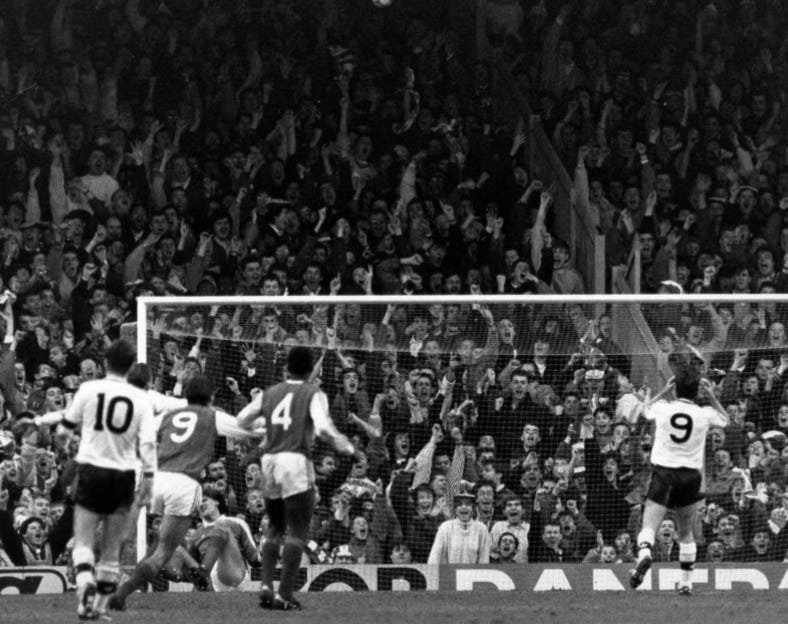
Brian McClair’s first season at Manchester United was chock-full of great moments. He scored 31 goals in all competitions, more than anyone in the top division, and became the first United player to score 20 in the league since George Best in 1967-68. Yet that season – and arguably his 11-year United career – is best remembered for the 32nd goal, the one he didn’t score. It came against Arsenal, in a tumultuous FA Cup tie, and is seen by many as the moment the rivalry went nuclear.
The league meetings earlier in the 1987-88 season hadn’t hinted at such radioactivity. The first, a 0-0 draw at Old Trafford in the second game of the season, was a black hole into which a lot of pre-season optimism disappeared. It was the first meeting since the Norman Conquest of January 1987, and both teams were on their best behaviour. The Times described the match as “impotent, colourless”.
United kept walking into Arsenal’s offside trap, marshalled with authority by the 20-year-old Tony Adams. Alex Ferguson had already praised Adams for his restraint during Norman Whiteside’s rampage earlier in the year, but this was the night he fell in love with a player he tried to sign on a number of occasions. “Adams,” said Ferguson after the game, “could be England’s centre-half for the next 20 years.”
Ferguson’s respect and admiration for Adams were intriguingly unaffected by a couple of high-profile errors against United, the first in the return fixture in January. It was a televised match – a rare occurrence in those days, which meant that any mistakes were dissected around the watercooler or kettle – and Adams was badly at fault for United’s winning goal. He stumbled over the ball and was dispossessed by Whiteside, who set up McClair for a simple finish.
United won 2-1, although Arsenal claimed a moral victory of sorts: Niall Quinn, who scored their equaliser, had two goals dubiously disallowed for pushing by the referee Roger Milford. Quinn says that, whenever they met after that, Milford apologised profusely. United’s opening goal, a bewitching solo effort from Gordon Strachan, was also controversial. Arsenal’s offside trap had ensnared McClair, and though he was nowhere near the line of vision for the goalkeeper John Lukic, many felt the goal should have been disallowed. In 1988, Bill Nicholson’s old line – “if he’s not interfering with play, what’s he doing on the pitch” – was an established part of the football lexicon.
A footnote to the game was Arsenal’s announcement, the same day, of the signing of Stoke’s 23-year-old right-back Lee Dixon for £375,000. While Dixon was being programmed on the training ground by George Graham – he would not become a regular until the following season – Arsenal used either Michael Thomas or Nigel Winterburn, the eventual successor to their left-back Kenny Sansom, on the other side.
That’s where Winterburn played when Arsenal met United at Highbury a month later in the fifth round of the FA Cup. It was a huge game for both sides, at a time when Liverpool were running away with the league; they were 12 points clear of second placed United with two games in hand. Arsenal were still in the Littlewoods Cup, and had won the first leg of their semi-final at Everton a few days earlier. But at a time when British clubs were banned from Europe, meaning you really were nothing if you finished second, United’s season hinged entirely on the FA Cup. And they were without their best player: Bryan Robson, who had started as a sweeper in the league match a month earlier, pulled a muscle playing for England in Israel in the week and missed the game. Wales supporters who never got to see Ryan Giggs play in an international friendly may have this match to blame. (The Monaco manager Arsene Wenger, whose team were coming towards the end of their two-month winter break, had more luck – he was not obliged to release his players, so while England played in Israel, Glenn Hoddle and Mark Hateley were in England playing friendlies against Aston Villa, Spurs and Newcastle.)
United could have done with the reassuring presence and defiance of Robson when they walked into one of the more poisonous atmospheres ever created at Highbury. The Arsenal historian Jon Spurling says he cannot remember Arsenal’s North Bank ever being noisier or more spiteful than it was that day. Arsenal had developed a powerful sense of injustice from matches against United, and that, along with the season-defining potential of the game, led to a thrillingly nasty mood.
An attendance of 54,161 was 25,000 more than for the league fixture a month earlier. With around 8,000 United fans also in the ground, a mood of primal hatred accompanied a pulsating game. “A cup tie indeed; a classical one,” wrote Brian Glanville in the Sunday Times. “The quality of the football may seldom have been very high, but the drama, particularly in the second half, was remarkable.”
Arsenal led 2-0 after a barnstorming first-half performance, with Alan Smith – whose goal was made by Winterburn – and an own goal from Mike Duxbury putting them in control. Smith’s goal was particularly important; it was only his second in 19 games, and a turning point in his fledgling Arsenal career. He became a deceptively prolific goalscorer who would win the Golden Boot in two of the next three seasons.
Without Robson, United again used Whiteside in midfield. This time he was not on his own patch and found it harder to administer vigilante justice, though he did his best with a wild early tackle on Kevin Richardson.
United, who may or may have experienced an early version of the hairdryer at half-time, were equally dominant for most of the second half. McClair’s adroit volley in the 51sth minute sparked a furious onslaught during which they missed a series of chances to equalise.
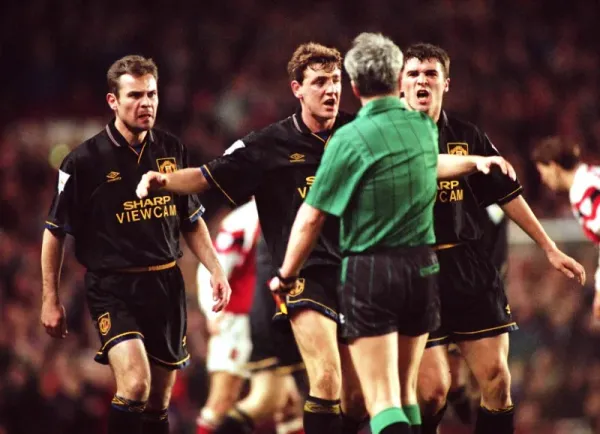
In the 89th minute, Whiteside made the most of a clumsy challenge from Thomas, falling over inelegantly to win a penalty. Arsenal went mad, surrounding the referee David Hutchinson, although the man who was penalised, Thomas, seemed to accept the decision without complaint. In the Guardian, David Lacey said Arsenal behaved like “street rioters … almost the entire team went into paroxysms of petulant rage”. While they did so, Whiteside discreetly nodded and winked at his team-mates. One of the first to congratulate him on winning the penalty was Viv Anderson.
There was a long delay before McClair could take the penalty, during which some Arsenal players threw mud at the ball. The volume of whistling – and the number of V-signs in McClair’s direction from behind the goal – increased to brain-melting levels. Then, as McClair ran up, the goalkeeper John Lukic started throwing his limbs in all directions; in the Guardian, Lacey said he was “dancing like a Zulu warrior”.
The environment was not exactly meditative, and a frazzled McClair smashed his penalty into orbit. It didn’t just go over the bar; it nearly cleared the North Bank. Had he equalised, United would have been favourites in a replay at Old Trafford, especially after such an emphatic second-half comeback, and Ferguson would have still had a chance of winning something in his first full season. McClair fucked that sky high.
As most of the Arsenal team ran over to have another go at the referee – it wasn’t immediately clear what this was designed to achieve – Winterburn sidled up to McClair and started walking shiftily alongside him. He looked like a ticket tout trying too hard to be discreet, muttering under his breath about face value and spares.
In reality he was offering an unsolicited appraisal of McClair’s penalty technique. It was a rare example of somebody trying to psych out a penalty taker after the event. McClair ignored him and started to jog up the field, so Winterburn ran after him. It was then that McClair turned round and wearily enquired: “Why don’t you fuck off?”
That bit of amateur lipreading aside, the precise details of Winterburn and McClair’s conversation has never been revealed. During an amiable chat on the Life With Brian podcast, both players confirmed they had no idea what they had said to each other. There are moments throughout history, in sport and art, where thousands are desperate to know exactly what was said: the end of the Radiohead video for Just, the end of the film Lost In Translation, Andrew Flintoff and Brett Lee’s handshake during the 2005 Ashes. With Winterburn and McClair, we have a pretty good idea. There’s no romance or mystery here, just a lot of asterisks.
While Winterburn’s behaviour was unusual, the cause was familiar: like so many footballers down the years, he simply had an overwhelming case of the battle fever. “It was nothing personal against Brian,” says Alan Smith. “He just happened to be taking the penalty at such a key time, and Nigel reacted in the heat of the moment. It could have been anyone.”
And that heat was volcanic. Many Arsenal fans regard this as the last great terrace experience at Highbury.
The clash between Winterburn and McClair wasn’t mentioned in most match reports, and only become a big thing over time. It stayed in McClair’s mind, though, and it’s a shame there is no video of his reaction – or an audio of his internal monologue – when Winterburn had a penalty saved in the Littlewoods Cup final two months later. Arsenal, 2-1 up at the time, went on to lose 3-2 to Luton.
McClair’s first opportunity for a bit of payback came in a 1-1 draw at Old Trafford the following season. “I had what could be called a falling-out with Winterburn,” he said in Odd Man Out. “The ball came out of the box and was dropping to me. Out of the corner of my eye I saw him coming towards me like a train. There was no way he was going to get the ball, so I had to avoid him. I jumped to stop being hurt and he ran straight into me. He was lying down and I got it into my head that he was pretending to be knocked out, so I grabbed him by the shirt and just shook him like a doll, shouting my head off. Then I let him go and he dropped flat and I just walked away.”
McClair, the most phlegmatic and eloquent of footballers, found himself behaving like a gangster. A groggy Winterburn was almost limp as he was helped from the field. He was at best winded and at worst concussed, though he returned to the field soon after and finished the game.
The match was played in vile conditions, which inevitably led to one or two comedy tackles. Dixon was booked for putting Giuliano Maiorana, a tricky left-winger making his full debut, into an advertising hoarding. Another young wide player, David Rocastle, had a shoving match with Mal Donaghy after a very late tackle on the United keeper Jim Leighton.
By this stage, the start of April, United’s season was again over. They were 10th in the league and out of both cup competitions, and 1988-89 remains their worst season since they were relegated in 1973-74. Arsenal, however, were seriously challenging for a first league title in 18 years. Their old friend Whiteside, who had been out for a year through injury, returned to the United team. He was subdued, although he did find time after the game to announce that Liverpool would do the Double. At that stage, few disagreed, as Arsenal’s form had collapsed. In a month, a 19-point lead over Liverpool – albeit having played four games more – had been whittled down to only two.
With Arsenal scheduled to visit Anfield three weeks later (the match was eventually be put back to late May because of the Hillsborough disaster) George Graham trialled a sweeper system at Old Trafford with a view to playing it against Liverpool. In those days, in English football at least, the tactic was seen as ultra-defensive: 5-4-1 rather than 3-4-3. The reality was a bit more nuanced.
The use of a sweeper meant that Adams played further to the left. And while Ferguson loved Adams, he was not blind to his weaknesses. Adams recalls Ferguson spending most of the game shouting “Show him on the left foot! He can't kick it with his left foot”. Not even Ferguson could have imagined what would eventually happen. In the 85th minute, shortly after giving Arsenal the lead with a lusty diving header, Adams tried to a clear an awkward, deflected cross with his left foot and shanked it slowly over John Lukic. It was the only goal United scored in five games that month.
“We did so well to get in front,” said Adams after the game, “and then I went and messed it up again.” He fronted up to the press, but the brave face was a lie. At that stage in his life, Adams had only one way to deal with pain: by drowning it in lager. The match was on a Sunday afternoon, again televised, so by the time Arsenal returned to London it was late. But Adams asked Paul Merson if he could stay at over and go for a lock-in at Merson’s local, the Rose and Crown in Sandridge. They drank till 4am, when Adams drove them home and slept on the new sofa bed that had been made up by Merson’s future wife, Lorraine. In the morning, when they folded up it back up, Merson realised Adams had wet the bed.
Shortly after, Merson received his daily delivery of the Mirror: on the back was a picture of Adams mocked up as a donkey, the nickname that would haunt him for the next few years. He had already received plenty of abuse for his part in England’s abysmal Euro 88 campaign, when he was given the runaround by Marco van Basten, and first heard donkey chants at West Ham the previous October.
The Mirror headline sent the abuse into overdrive. During Arsenal’s next away game at Middlesbrough, Adams was pelted with carrots throughout. One hit him flush on the ear, which was swollen and needed treatment after the game.
Adams kept his game-face on for public consumption. Nobody really considered that he might be struggling. He was 22, the captain of Arsenal Football Club, challenging for the league title, earning a decent wage. He was living the dream. “Privately, in all honesty, it hurt like hell and the only way I knew how to deal with that pain was to get drunk and get on with the next game,” he said in Addicted. “Drink and football, my two saviours.”
At the time, Adams was seen as a symbol of English football’s inadequacies: unsophisticated, loutish and technically inadequate. Before the epiphany of Italia 90, the state of English football was a constant watercooler subject, triggered by anything from hooliganism to a poor first touch. The majority of Arsenal-United games in the late 80s were also used in evidence. The reports of Arsenal’s home victories in the 1988-89 and 1989-90 seasons, in particular, focussed on the poverty of the entertainment. The latter, a televised match that was highly conducive to a Sunday afternoon siesta, was savaged in the broadsheets.
“The fixture offered a startling condemnation of the lowly standards to which the English game has sunk …,” said Stuart Jones in the Times. “There was no wit, little invention and scarcely any genuine quality.” It may or may not have been a coincidence that this was the last Arsenal-United game without any foreign players on the field.
The poverty of the football was even more startling because of the grandeur of both clubs – and especially because Arsenal were the reigning champions at the time. They had won the league, their first title since the 1970-71, on a legendary night at Anfield in May 1989. You know the story: Arsenal need a two-goal win, the world gives them precisely 0.00 per cent chance, Thomas gives them a 2-0 win with almost the last kick of the season. It was an exceedingly popular triumph in Manchester. Ferguson hated Liverpool, and watched the game in his bedroom, having told his wife Cathy not to put any phonecalls through. “When Thomas scored,” he said in My Autobiography, “I went berserk.”
He then went berserk in the transfer market. Over the next few months Ferguson spent around £8.25m on five players: Neil Webb, Mike Phelan, Gary Pallister, Paul Ince and Danny Wallace. At that stage it was the most ever spent by an English club in a single summer. (He also had talks with the young Aston Villa defender Martin Keown, who instead chose to join Everton.)
Arsenal’s title victory influenced Ferguson’s spending spree. “I had this gut feeling that if I didn’t have a go I wasn’t going to make it as a soccer boss this side of the border,” he said in 6 Years at United. “George [Graham] had challenged the might of Anfield and come out on top. He had built a resourceful club and it was maybe his winning of the league title which gave me the impetus I needed. I resolved there and then that if he could do it so could I.”
In the opening game of the new season, United’s expensive team thumped the champions Arsenal 4-1 at Old Trafford, with Webb scoring a beautiful, swirling volley on his debut. Early in that game, with United leading 1-0, McClair had a penalty saved by John Lukic. This time there was no reaction from Winterburn.
The penalty was conceded in strange circumstances by Adams. As he waited for the ball to drop, he shoved Bruce with the force usually reserved for pushing broken-down cars. He was substituted soon after. It turned out he had been unwell, largely because his roommate, who Adams declined to name, had been smoking constantly overnight. Football loves a whodunnit – whodoesn’t – and some cursory sleuthing suggests he was rooming with Martin Hayes at the time.
Adams wasn’t the only one struggling physically. Arsenal had been round the globe in pre-season, including a challenge match against the Argentinian champions Independiente in Miami, and most of the players were knackered. “Their stomachs were in Sweden, their heads in America and their feet in England,” said the winger Brian Marwood, who had missed the American trip and was one of the fresher players. Their pre-season exertions explain why they faded so badly in the last quarter of the game. On the coach home, a number of players skipped the post-match meal and beers and were asleep soon after leaving Manchester. “You would have thought it was the end of the season – not the beginning,” said Marwood.
Not that United cared. The scoreline was flattering, but on the opening day of the season optimism always trumps logic. And there was stratospheric optimism at Old Trafford. Their prospective new owner Michael Knighton, who had agreed to buy the club for £20m, dressed up in full United kit to juggle a ball in front of Stretford End before the game.
Knighton couldn’t juggle his finances anywhere near as effectively, and that idyllic day against Arsenal proved to be a false dawn for him, Webb and Ferguson. Webb suffered a bad Achilles injury on England duty and was never the same player, while Ferguson endured the most torrid season of his career before eventually winning the FA Cup.
By the time the two sides met again in December 1989, the game that heightened the panic about standards in English football, United were back in 12th place and about to embark on a miserable run of 11 games without a league win. Arsenal beat them more comfortably than the 1-0 scoreline suggested. “[The match] was rather like a Sunday suit,” wrote David Lacey in the Guardian. “Dull and stiff and smelling slightly of mothballs.” It was the start of what United fans later called Black December. Six days later, Ferguson omitted Mark Hughes and United lost at home to newly promoted Crystal Palace. After the match, a United fan in the Stretford End held up a banner that read: “Three years of excuses and it’s still crap. Ta-ra Fergie.”
“United weren’t very good,” says Lee Dixon. “When we won the league in 1991 we beat them 3-1 in our last home game, and they were shit. Back then it was a case of, ‘We’ve got United at home so there’s another three points.’”
In that 1990-91 season, Arsenal picked up three points against United at home and away. But they only got to keep four of them.