
I'll See You Out There
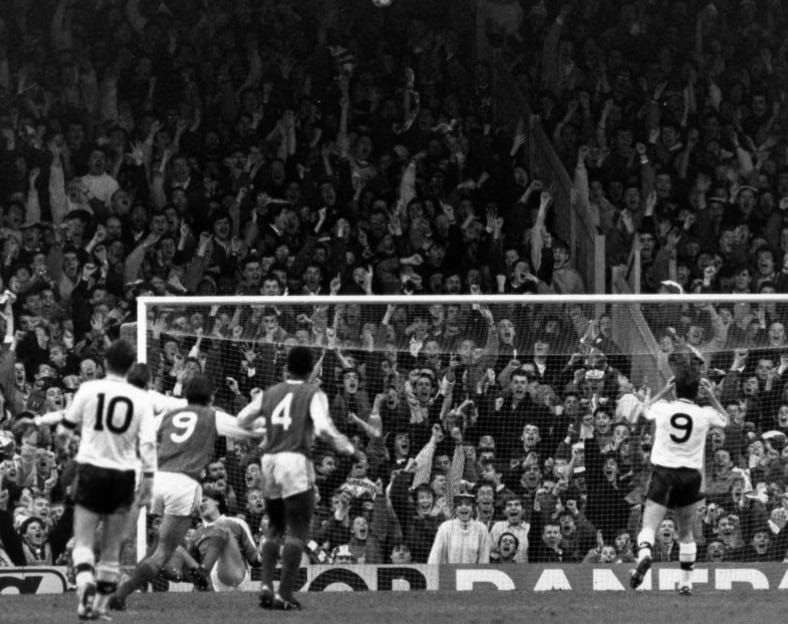
Brian McClair’s first season at Manchester United was chock-full of great moments. He scored 31 goals in all competitions, more than anyone in the top division, and became the first United player to score 20 in the league since George Best in 1967-68. Yet that season – and arguably his 11-year United career – is best remembered for the 32nd goal, the one he didn’t score. It came against Arsenal, in a tumultuous FA Cup tie, and is seen by many as the moment the rivalry went nuclear.
The league meetings earlier in the 1987-88 season hadn’t hinted at such radioactivity. The first, a 0-0 draw at Old Trafford in the second game of the season, was a black hole into which a lot of pre-season optimism disappeared. It was the first meeting since the Norman Conquest of January 1987, and both teams were on their best behaviour. The Times described the match as “impotent, colourless”.
United kept walking into Arsenal’s offside trap, marshalled with authority by the 20-year-old Tony Adams. Alex Ferguson had already praised Adams for his restraint during Norman Whiteside’s rampage earlier in the year, but this was the night he fell in love with a player he tried to sign on a number of occasions. “Adams,” said Ferguson after the game, “could be England’s centre-half for the next 20 years.”
Ferguson’s respect and admiration for Adams were intriguingly unaffected by a couple of high-profile errors against United, the first in the return fixture in January. It was a televised match – a rare occurrence in those days, which meant that any mistakes were dissected around the watercooler or kettle – and Adams was badly at fault for United’s winning goal. He stumbled over the ball and was dispossessed by Whiteside, who set up McClair for a simple finish.
United won 2-1, although Arsenal claimed a moral victory of sorts: Niall Quinn, who scored their equaliser, had two goals dubiously disallowed for pushing by the referee Roger Milford. Quinn says that, whenever they met after that, Milford apologised profusely. United’s opening goal, a bewitching solo effort from Gordon Strachan, was also controversial. Arsenal’s offside trap had ensnared McClair, and though he was nowhere near the line of vision for the goalkeeper John Lukic, many felt the goal should have been disallowed. In 1988, Bill Nicholson’s old line – “if he’s not interfering with play, what’s he doing on the pitch” – was an established part of the football lexicon.
A footnote to the game was Arsenal’s announcement, the same day, of the signing of Stoke’s 23-year-old right-back Lee Dixon for £375,000. While Dixon was being programmed on the training ground by George Graham – he would not become a regular until the following season – Arsenal used either Michael Thomas or Nigel Winterburn, the eventual successor to their left-back Kenny Sansom, on the other side.
That’s where Winterburn played when Arsenal met United at Highbury a month later in the fifth round of the FA Cup. It was a huge game for both sides, at a time when Liverpool were running away with the league; they were 12 points clear of second placed United with two games in hand. Arsenal were still in the Littlewoods Cup, and had won the first leg of their semi-final at Everton a few days earlier. But at a time when British clubs were banned from Europe, meaning you really were nothing if you finished second, United’s season hinged entirely on the FA Cup. And they were without their best player: Bryan Robson, who had started as a sweeper in the league match a month earlier, pulled a muscle playing for England in Israel in the week and missed the game. Wales supporters who never got to see Ryan Giggs play in an international friendly may have this match to blame. (The Monaco manager Arsene Wenger, whose team were coming towards the end of their two-month winter break, had more luck – he was not obliged to release his players, so while England played in Israel, Glenn Hoddle and Mark Hateley were in England playing friendlies against Aston Villa, Spurs and Newcastle.)
United could have done with the reassuring presence and defiance of Robson when they walked into one of the more poisonous atmospheres ever created at Highbury. The Arsenal historian Jon Spurling says he cannot remember Arsenal’s North Bank ever being noisier or more spiteful than it was that day. Arsenal had developed a powerful sense of injustice from matches against United, and that, along with the season-defining potential of the game, led to a thrillingly nasty mood.
An attendance of 54,161 was 25,000 more than for the league fixture a month earlier. With around 8,000 United fans also in the ground, a mood of primal hatred accompanied a pulsating game. “A cup tie indeed; a classical one,” wrote Brian Glanville in the Sunday Times. “The quality of the football may seldom have been very high, but the drama, particularly in the second half, was remarkable.”
This post is for subscribers only
Subscribe now and have access to all our stories, enjoy exclusive content and stay up to date with constant updates.
Already a member? Sign in